SITE MAP
DIVINE TRAVELS
TOURS & RETREATS
LINKS TO THIS
PAGE:
Peru Tour
CLICK HERE for Itinerary
Peru
travel information:
CLICK HERE
Testimonials from previous tours:
CLICK HERE
For Tour Fees
Or to Register:
CLICK HERE
Email Us:

For Tour Fees
Or to Register:
CLICK HERE
Email Us:
For Tour Fees
Or to Register:
CLICK HERE
Email Us:
SITE MAP
DIVINE TRAVELS
TOURS & RETREATS
LINKS TO THIS
PAGE:
Peru Tour
CLICK HERE for Itinerary
Peru
travel information:
CLICK HERE
Testimonials from previous tours:
CLICK HERE
For Tour Fees
Or to Register:
CLICK HERE
Email Us:
For Tour Fees
Or to Register:
CLICK HERE
Email Us:
SITE MAP
DIVINE TRAVELS
TOURS & RETREATS
LINKS TO THIS
PAGE:
Peru Tour
CLICK HERE for Itinerary
Peru
travel information:
CLICK HERE
Testimonials from previous tours:
CLICK HERE
For Tour Fees
Or to Register:
CLICK HERE
Email Us:
For Tour Fees
Or to Register:
CLICK HERE
Email Us:
SITE MAP
DIVINE TRAVELS
TOURS & RETREATS
LINKS TO THIS
PAGE:
Peru Tour
CLICK HERE for Itinerary
Peru
travel information:
CLICK HERE
Testimonials from previous tours:
CLICK HERE
For Tour Fees
Or to Register:
CLICK HERE
Email Us:
For Tour Fees
Or to Register:
CLICK HERE
Email Us:
FFor Tour Fees
Or to Register:
CLICK HERE
Email Us:
SITE MAP
DIVINE TRAVELS
TOURS & RETREATS
LINKS TO THIS
PAGE:
Peru Tour
CLICK HERE for Itinerary
Peru
travel information:
CLICK HERE
Testimonials from previous tours:
CLICK HERE
For Tour Fees
Or to Register:
CLICK HERE
Email Us:
For Tour Fees
Or to Register:
CLICK HERE
Email Us:
SITE MAP
DIVINE TRAVELS
TOURS & RETREATS
LINKS TO THIS
PAGE:
Peru Tour
CLICK HERE for Itinerary
Peru
travel information:
CLICK HERE
Testimonials from previous tours:
CLICK HERE
For Tour Fees
Or to Register:
CLICK HERE
Email Us:
For Tour Fees
Or to Register:
CLICK HERE
Email Us:
SITE MAP
DIVINE TRAVELS
TOURS & RETREATS
LINKS TO THIS
PAGE:
Peru Tour
CLICK HERE for Itinerary
Peru
travel information:
CLICK HERE
Testimonials from previous tours:
CLICK HERE
For Tour Fees
Or to Register:
CLICK HERE
Email Us:
SITE MAP
DIVINE TRAVELS
TOURS & RETREATS
LINKS TO THIS
PAGE:
Peru Tour
CLICK HERE for Itinerary
Peru
travel information:
CLICK HERE
Testimonials from previous tours:
CLICK HERE
For Tour Fees
Or to Register:
CLICK HERE
Email Us:
For Tour Fees
Or to Register:
CLICK HERE
Email Us:
For Tour Fees
Or to Register:
CLICK HERE
Email Us:
SITE MAP
DIVINE TRAVELS
TOURS & RETREATS
LINKS TO THIS
PAGE:
Peru Tour
CLICK HERE for Itinerary
Peru
travel information:
CLICK HERE
Testimonials from previous tours:
CLICK HERE
For Tour Fees
Or to Register:
CLICK HERE
Email Us:
For Tour Fees
Or to Register:
CLICK HERE
Email Us:
SITE MAP
DIVINE TRAVELS
TOURS & RETREATS
LINKS TO THIS
PAGE:
Peru Tour
CLICK HERE for Itinerary
Peru
travel information:
CLICK HERE
Testimonials from previous tours:
CLICK HERE
For Tour Fees
Or to Register:
CLICK HERE
Email Us:
For Tour Fees
Or to Register:
CLICK HERE
Email Us:
SITE MAP
DIVINE TRAVELS
TOURS & RETREATS
LINKS TO THIS
PAGE:
Peru Tour
CLICK HERE for Itinerary
Peru
travel information:
CLICK HERE
Testimonials from previous tours:
CLICK HERE
For Tour Fees
Or to Register:
CLICK HERE
Email Us:
For Tour Fees
Or to Register:
CLICK HERE
Email Us:
For Tour Fees
Or to Register:
CLICK HERE
Email Us:
SITE MAP
DIVINE TRAVELS
TOURS & RETREATS
LINKS TO THIS
PAGE:
Peru Tour
CLICK HERE for Itinerary
Peru
travel information:
CLICK HERE
Testimonials from previous tours:
CLICK HERE
For Tour Fees
Or to Register:
CLICK HERE
Email Us:
For Tour Fees
Or to Register:
CLICK HERE
Email Us:
SITE MAP
DIVINE TRAVELS
TOURS & RETREATS
LINKS TO THIS
PAGE:
Peru Tour
CLICK HERE for Itinerary
Peru
travel information:
CLICK HERE
Testimonials from previous tours:
CLICK HERE
For Tour Fees
Or to Register:
CLICK HERE
Email Us:
For Tour Fees
Or to Register:
CLICK HERE
Email Us:
SITE MAP
DIVINE TRAVELS
TOURS & RETREATS
LINKS TO THIS
PAGE:
Peru Tour
CLICK HERE for Itinerary
Peru
travel information:
CLICK HERE
Testimonials from previous tours:
CLICK HERE
For Tour Fees
Or to Register:
CLICK HERE
Email Us:
SITE MAP
DIVINE TRAVELS
TOURS & RETREATS
LINKS TO THIS
PAGE:
Peru Tour
CLICK HERE for Itinerary
Peru
travel information:
CLICK HERE
Testimonials from previous tours:
CLICK HERE
For Tour Fees
Or to Register:
CLICK HERE
Email Us:
For Tour Fees
Or to Register:
CLICK HERE
Email Us:
For Tour Fees
Or to Register:
CLICK HERE
Email Us:
SITE MAP
DIVINE TRAVELS
TOURS & RETREATS
LINKS TO THIS
PAGE:
Peru Tour
CLICK HERE for Itinerary
Peru
travel information:
CLICK HERE
Testimonials from previous tours:
CLICK HERE
For Tour Fees
Or to Register:
CLICK HERE
Email Us:
SITE MAP
DIVINE TRAVELS
TOURS & RETREATS
LINKS TO THIS
PAGE:
Peru Tour
CLICK HERE for Itinerary
Peru
travel information:
CLICK HERE
Testimonials from previous tours:
CLICK HERE
For Tour Fees
Or to Register:
CLICK HERE
Email Us:
SITE MAP
DIVINE TRAVELS
TOURS & RETREATS
LINKS TO THIS
PAGE:
Peru Tour
CLICK HERE for Itinerary
Peru
travel information:
CLICK HERE
Testimonials from previous tours:
CLICK HERE
For Tour Fees
Or to Register:
CLICK HERE
Email Us:
For Tour Fees
Or to Register:
CLICK HERE
Email Us:
For Tour Fees
Or to Register:
CLICK HERE
Email Us:
SITE MAP
DIVINE TRAVELS
TOURS & RETREATS
LINKS TO THIS
PAGE:
Peru Tour
CLICK HERE for Itinerary
Peru
travel information:
CLICK HERE
Testimonials from previous tours:
CLICK HERE
For Tour Fees
Or to Register:
CLICK HERE
Email Us:
For Tour Fees
Or to Register:
CLICK HERE
Email Us:
SITE MAP
DIVINE TRAVELS
TOURS & RETREATS
LINKS TO THIS
PAGE:
Peru Tour
CLICK HERE for Itinerary
Peru
travel information:
CLICK HERE
Testimonials from previous tours:
CLICK HERE
For Tour Fees
Or to Register:
CLICK HERE
Email Us:
For Tour Fees
Or to Register:
CLICK HERE
Email Us:
SITE MAP
DIVINE TRAVELS
TOURS & RETREATS
LINKS TO THIS
PAGE:
Peru Tour
CLICK HERE for Itinerary
Peru
travel information:
CLICK HERE
Testimonials from previous tours:
CLICK HERE
For Tour Fees
Or to Register:
CLICK HERE
Email Us:
SITE MAP
DIVINE TRAVELS
TOURS & RETREATS
SITE MAP
DIVINE TRAVELS
TOURS & RETREATS
LINKS TO THIS
PAGE:
Peru Tour
CLICK HERE for Itinerary
Peru
travel information:
CLICK HERE
Testimonials from previous tours:
CLICK HERE
For Tour Fees
Or to Register:
CLICK HERE
Email Us:
For Tour Fees
Or to Register:
CLICK HERE
Email Us:
For Tour Fees
Or to Register:
CLICK HERE
Email Us:
SITE MAP
DIVINE TRAVELS
TOURS & RETREATS
LINKS TO THIS
PAGE:
Peru Tour
CLICK HERE for Itinerary
Peru
travel information:
CLICK HERE
Testimonials from previous tours:
CLICK HERE
For Tour Fees
Or to Register:
CLICK HERE
Email Us:
For Tour Fees
Or to Register:
CLICK HERE
Email Us:
SITE MAP
DIVINE TRAVELS
TOURS & RETREATS
LINKS TO THIS
PAGE:
Peru Tour
CLICK HERE for Itinerary
Peru
travel information:
CLICK HERE
Testimonials from previous tours:
CLICK HERE
For Tour Fees
Or to Register:
CLICK HERE
Email Us:
For Tour Fees
Or to Register:
CLICK HERE
Email Us:
SITE MAP
DIVINE TRAVELS
TOURS & RETREATS
LINKS TO THIS
PAGE:
Peru Tour
CLICK HERE for Itinerary
Peru
travel information:
CLICK HERE
Testimonials from previous tours:
CLICK HERE
For Tour Fees
Or to Register:
CLICK HERE
Email Us:
For Tour Fees
Or to Register:
CLICK HERE
Email Us:
For Tour Fees
Or to Register:
CLICK HERE
Email Us:
SITE MAP
DIVINE TRAVELS
TOURS & RETREATS
LINKS TO THIS
PAGE:
Peru Tour
CLICK HERE for Itinerary
Peru
travel information:
CLICK HERE
Testimonials from previous tours:
CLICK HERE
For Tour Fees
Or to Register:
CLICK HERE
Email Us:
For Tour Fees
Or to Register:
CLICK HERE
Email Us:
SITE MAP
DIVINE TRAVELS
TOURS & RETREATS
LINKS TO THIS
PAGE:
Peru Tour
CLICK HERE for Itinerary
Peru
travel information:
CLICK HERE
Testimonials from previous tours:
CLICK HERE
For Tour Fees
Or to Register:
CLICK HERE
Email Us:
For Tour Fees
Or to Register:
CLICK HERE
Email Us:
SITE MAP
DIVINE TRAVELS
TOURS & RETREATS
LINKS TO THIS
PAGE:
Peru Tour
CLICK HERE for Itinerary
Peru
travel information:
CLICK HERE
Testimonials from previous tours:
CLICK HERE
For Tour Fees
Or to Register:
CLICK HERE
Email Us:
SITE MAP
DIVINE TRAVELS
TOURS & RETREATS
SITE MAP
DIVINE TRAVELS
TOURS & RETREATS
LINKS TO THIS
PAGE:
Peru Tour
CLICK HERE for Itinerary
Peru
travel information:
CLICK HERE
Testimonials from previous tours:
CLICK HERE
For Tour Fees
Or to Register:
CLICK HERE
Email Us:
For Tour Fees
Or to Register:
CLICK HERE
Email Us:
For Tour Fees
Or to Register:
CLICK HERE
Email Us:
SITE MAP
DIVINE TRAVELS
TOURS & RETREATS
LINKS TO THIS
PAGE:
Peru Tour
CLICK HERE for Itinerary
Peru
travel information:
CLICK HERE
Testimonials from previous tours:
CLICK HERE
For Tour Fees
Or to Register:
CLICK HERE
Email Us:
For tour fees
or to register for
our Peru tours on
our secure server:
SITE MAP
DIVINE TRAVELS
TOURS & RETREATS
LINKS TO THIS
PAGE:
Peru Tour
CLICK HERE for Itinerary
Peru
travel information:
CLICK HERE
Testimonials from previous tours:
CLICK HERE
For Tour Fees
Or to Register:
CLICK HERE
Email Us:
For Tour Fees
Or to Register:
CLICK HERE
Email Us:
SITE MAP
DIVINE TRAVELS
TOURS & RETREATS
LINKS TO THIS
PAGE:
Peru Tour
CLICK HERE for Itinerary
Peru
travel information:
CLICK HERE
Testimonials from previous tours:
CLICK HERE
For Tour Fees
Or to Register:
CLICK HERE
Email Us:
For Tour Fees
Or to Register:
CLICK HERE
Email Us:
For Tour Fees
Or to Register:
CLICK HERE
Email Us:
SITE MAP
DIVINE TRAVELS
TOURS & RETREATS
LINKS TO THIS
PAGE:
Peru Tour
CLICK HERE for Itinerary
Peru
travel information:
CLICK HERE
Testimonials from previous tours:
CLICK HERE
For Tour Fees
Or to Register:
CLICK HERE
Email Us:
For Tour Fees
Or to Register:
CLICK HERE
Email Us:
SITE MAP
DIVINE TRAVELS
TOURS & RETREATS
LINKS TO THIS
PAGE:
Peru Tour
CLICK HERE for Itinerary
Peru
travel information:
CLICK HERE
Testimonials from previous tours:
CLICK HERE
For Tour Fees
Or to Register:
CLICK HERE
Email Us:
For Tour Fees
Or to Register:
CLICK HERE
Email Us:
SITE MAP
DIVINE TRAVELS
TOURS & RETREATS
LINKS TO THIS
PAGE:
Peru Tour
CLICK HERE for Itinerary
Peru
travel information:
CLICK HERE
Testimonials from previous tours:
CLICK HERE
For Tour Fees
Or to Register:
CLICK HERE
Email Us:
SITE MAP
DIVINE TRAVELS
TOURS & RETREATS
SITE MAP
DIVINE TRAVELS
TOURS & RETREATS
LINKS TO THIS
PAGE:
Peru Tour
CLICK HERE for Itinerary
Peru
travel information:
CLICK HERE
Testimonials from previous tours:
CLICK HERE
For Tour Fees
Or to Register:
CLICK HERE
Email Us:
For Tour Fees
Or to Register:
CLICK HERE
Email Us:
For Tour Fees
Or to Register:
CLICK HERE
Email Us:
SITE MAP
DIVINE TRAVELS
TOURS & RETREATS
LINKS TO THIS
PAGE:
Peru Tour
CLICK HERE for Itinerary
Peru
travel information:
CLICK HERE
Testimonials from previous tours:
CLICK HERE
For Tour Fees
Or to Register:
CLICK HERE
Email Us:
For Tour Fees
Or to Register:
CLICK HERE
Email Us:
SITE MAP
DIVINE TRAVELS
TOURS & RETREATS
LINKS TO THIS
PAGE:
Peru Tour
CLICK HERE for Itinerary
Peru
travel information:
CLICK HERE
Testimonials from previous tours:
CLICK HERE
For Tour Fees
Or to Register:
CLICK HERE
Email Us:
For Tour Fees
Or to Register:
CLICK HERE
Email Us:
SITE MAP
DIVINE TRAVELS
TOURS & RETREATS
LINKS TO THIS
PAGE:
Peru Tour
CLICK HERE for Itinerary
Peru
travel information:
CLICK HERE
Testimonials from previous tours:
CLICK HERE
For Tour Fees
Or to Register:
CLICK HERE
Email Us:
For Tour Fees
Or to Register:
CLICK HERE
Email Us:
For Tour Fees
Or to Register:
CLICK HERE
Email Us:
SITE MAP
DIVINE TRAVELS
TOURS & RETREATS
LINKS TO THIS
PAGE:
Peru Tour
CLICK HERE for Itinerary
Peru
travel information:
CLICK HERE
Testimonials from previous tours:
CLICK HERE
For Tour Fees
Or to Register:
CLICK HERE
Email Us:
For Tour Fees
Or to Register:
CLICK HERE
Email Us:
SITE MAP
DIVINE TRAVELS
TOURS & RETREATS
LINKS TO THIS
PAGE:
Peru Tour
CLICK HERE for Itinerary
Peru
travel information:
CLICK HERE
Testimonials from previous tours:
CLICK HERE
For Tour Fees
Or to Register:
CLICK HERE
Email Us:
For Tour Fees
Or to Register:
CLICK HERE
Email Us:
SITE MAP
DIVINE TRAVELS
TOURS & RETREATS
LINKS TO THIS
PAGE:
Peru Tour
CLICK HERE for Itinerary
Peru
travel information:
CLICK HERE
Testimonials from previous tours:
CLICK HERE
For tour fees
or to register for
our Peru tours on
our secure server:
SITE MAP
DIVINE TRAVELS
TOURS & RETREATS
SITE MAP
DIVINE TRAVELS
TOURS & RETREATS
LINKS TO THIS
PAGE:
Peru Tour
CLICK HERE for Itinerary
Peru
travel information:
CLICK HERE
Testimonials from previous tours:
CLICK HERE
For Tour Fees
Or to Register:
CLICK HERE
Email Us:
For tour fees
or to register for
our Peru tours on
our secure server
CLICK HERE
For Tour Fees
Or to Register:
CLICK HERE
Email Us:
SITE MAP
DIVINE TRAVELS
TOURS & RETREATS
LINKS TO THIS
PAGE:
Peru Tour
CLICK HERE for Itinerary
Peru
travel information:
CLICK HERE
Testimonials from previous tours:
CLICK HERE
For Tour Fees
Or to Register:
CLICK HERE
Email Us:
For Tour Fees
Or to Register:
CLICK HERE
Email Us:
|
The
Experience of a Lifetime Begins Here.
|
SHAMANIC
JOURNEYS--MAGIC IN THE ANDES
Because this is
the rare, precious opportunity you've been waiting for! Unlike
other tours to Peru, you will experience sacred sites and power
vortexes intimately and profoundly.
This is not just
a tour, but a spiritual journey.
 Breathe in the sacred wisdom of the ages. Meditate in
temples thousands of years old. Participate in life-changing
ancient ceremonies and experience the magnificence of your own
being. Picture yourself breathing the mystical air at the heights
of the Andes Mountains. Your spirit will soar as you experience one
of the most beautiful and sacred lands on earth. Walk in the
footsteps of the ancient Inkas. The ancestors of the Andean people
still live in this precious "Paradise in the Sun," where the heart
of the masters still reigns. Breathe in the sacred wisdom of the ages. Meditate in
temples thousands of years old. Participate in life-changing
ancient ceremonies and experience the magnificence of your own
being. Picture yourself breathing the mystical air at the heights
of the Andes Mountains. Your spirit will soar as you experience one
of the most beautiful and sacred lands on earth. Walk in the
footsteps of the ancient Inkas. The ancestors of the Andean people
still live in this precious "Paradise in the Sun," where the heart
of the masters still reigns.
Once again, the
world has begun to recognize the Andes as one of the greatest
cultural and spiritual centers of the planet. The doors to new
dimensions of awareness are opening to us, and we are now
unearthing and reviving ancient, hidden knowledge, due to the
beginning of the new, tenth Pachakuti, or cosmic cycle. Andean
history is divided into segments of 1000 years, with a
transformational era in the middle, every 500 years. We recently
passed one of these historical transitions in 1992. The ANDEAN
PEOPLE call this Pachakuti "turning of the times." Since long ago
the Andean culture zealously guarded their secrets. Now they are
willing to share this ancient knowledge. Are you ready to
experience your true nature? Now is the time to participate in
sacred ceremonies from an ancient, highly advanced
civilization.
The Kondors of
the South are calling the Eagles of the North. Some of you will
know in your heart that you must go, you must experience this
sacred wisdom in the "Paradise of the Sun."
OUR ANDEAN TOUR GUIDE:
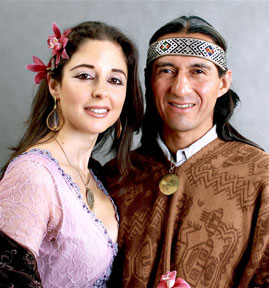
MALLKU
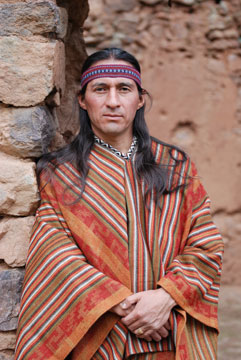 As
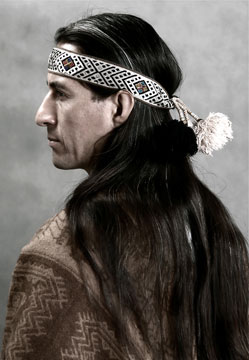
we visit the sacred sites, the famous Andean Shaman named MALLKU,
who lives, talks, and breathes the Way of the Ageless Inkas, will
be our guide to ancient rituals and ceremonies, whose secrets have
been guarded from time immemorial. As
we visit the sacred sites, the famous Andean Shaman named MALLKU,
who lives, talks, and breathes the Way of the Ageless Inkas, will
be our guide to ancient rituals and ceremonies, whose secrets have
been guarded from time immemorial.
Our
expert guide MALLKU is the #1 foremost expert on Andean sacred
archeology, internationally renowned shaman, author, spiritual
leader, visionary photographer, and archeo-astronomer.
MALLKU is the man who singlehandedly discovered and
uncovered the astronomical observatories used by the ancients and
the shadows cast at the sacred sites during the solstices and
equinoxes. As the ultimate authority, the secrets revealed in
Mallku's books are used by all other Peruvian tour guides to
describe the sacred sites. Mallku is the shaman that guided Jonette
Crowley on her mystical initiation described in her famous book The
Eagle and the Condor, A True Story of an Unexpected Mystical
Journey.
On our tour, Mallku leads us in ceremonies, meditations,
offerings, and rituals. Recognized by spiritual leaders worldwide
for his expertise in determining the authentic use of Inkan sites,
he follows the ancient path of the wisdom tradition of the Andes.
Mallku has been an artist and an advocate of the Andean Culture
since his youth. With incredible dedication, since the age of 9, he meditated repeatedly
at Andean sacred sites, where he  uncovered astronomical alignments
previously hidden from view. uncovered astronomical alignments
previously hidden from view.
The
Andean architects were not only the builders of incredible
structures, but also the masters of the power lines (ley-lines as
known in western geomancy) existing on the Earth. Mallku has
uncovered unprecedented, significant discoveries about these
geo-magnetic forces. His lectures and ceremonies demonstrate the
importance of astronomical phenomena in the design and placement of
the ancient temples. The Ancients understood and worked with
geo-magnetic forces, so their temples and palaces would became
power places that amplify spiritual essences and high energies of
Pachamama and Wiraqocha. Cuzco city is an example of this conscious
style of architecture, where the Sun's pattern is extensively
mapped to the equinoxes and solstices. The design of the city
reflects this in every aspect. In the last 20 years of studies,
Mallku has discovered some of the most important astronomical
phenomena that are still visible at many of these "power places."
He describes these ancient Andean buildings, the expression of an
advanced "Feng Shui" technology, and the Andean architects, as
masters of the spiritual path.
Mallku, a sensitive artist and a promoter of Andean
culture, collaborated during the 1980's as co-editor of books on
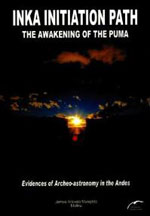
Natural Medicine. In 1997 he presented his book Inka Initiation
Path: the Awakening of the Puma, in which he revealed his expertise
in the Esoteric knowledge within Andean archaeo-astronomy. In 1999
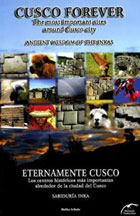
he paid tribute to the Sacred City af Machu Picchu in his book
Machu Picchu Forever: City of Pilgrims. His extensive research has
earned him well-deserved recognition and fame. MALLKU is an
international lecturer and teaches the ancient culture of the
Andes, promoting a Shamanic experience as one of the paths of
liberation for the present generation. In his latest book Inka
Power Places: Solar Initiations, he reveals important secrets of
the Initiation Knowledge of the Amauta Sages, which were expressed
in their Temples, Palaces and Cities as testimony for all
time.
Mallku co-authored books on natural medicine and Andean
mysticism in the 1980's and authored his own brilliantly written
books in the 1990's. His shamanic way of life led him to the
spiritual communities of Peru and Brazil, furthering his
experiences in the magical dimensions of Pachamama and
Wiraqocha.
This
path of sensitivity has permitted Mallku to relive the message of
his ancestors over the years. His artistic vision is expressed
through his photography, where he captures natures magical moments.
His works have been presented in exhibitions and conferences
worldwide.
"The Unknowable is not any of the deities, but all of
them are contained within its mystery."--teaching of Asuncion
Acctu, wise elder of Pachakamaq.
LINKS TO
OUR TOURS:
Testimonials from previous tours: CLICK HERE or Scroll down
Peru Tour with MALLKU:
CLICK HERE
for Itinerary or Scroll down
Important travel information for Peru:
CLICK HERE
or Scroll
down
|
TESTIMONIALS from Peru Tour Participants
 "I want to thank you for a fabulous trip to Peru. Although I had searched for a spiritual trip to Peru, the trip I actually took went before my wildest expectations. It was both an inner journey of overcoming one's challenges (which for me involved some physical limitations) as well as the actual amazing trip to experience Peru with such advanced spiritual leaders as you both (Mallku and Alanna). Thanks for the experiences, all the wonderful ceremonies, and all the care and concern you both gave to us as travelers on our path along the way. I know it was a bit trying at times and I also know that you often went beyond what was planned. I really appreciate all you did for us. It was a trip that I will never forget. Thanks so much."--Joanne Aaronson, Rev., PMP, EIIS, Intuitive Life Coach & Pastoral Counselor, Virginia. "I want to thank you for a fabulous trip to Peru. Although I had searched for a spiritual trip to Peru, the trip I actually took went before my wildest expectations. It was both an inner journey of overcoming one's challenges (which for me involved some physical limitations) as well as the actual amazing trip to experience Peru with such advanced spiritual leaders as you both (Mallku and Alanna). Thanks for the experiences, all the wonderful ceremonies, and all the care and concern you both gave to us as travelers on our path along the way. I know it was a bit trying at times and I also know that you often went beyond what was planned. I really appreciate all you did for us. It was a trip that I will never forget. Thanks so much."--Joanne Aaronson, Rev., PMP, EIIS, Intuitive Life Coach & Pastoral Counselor, Virginia.
"Everything on the Peru tour was
far more than I imagined. I do not think that I would have tested
my power to the extent that I did, had it not been for Mallku. He
is amazing and I would recommend this tour to anyone who seeks to
journey to Peru." --Nadira Ramtahal, New York.
"I enjoyed my Peru tour and
Mallku very much. I shall always remember the awesome mountains and
Inka ruins,the trainride to Agua Calientes and climbing up to Machu
Picchu. The Sacred Valley and the wonderful meditations I
experienced. I shall keep it in my heart forever. I loved the view
from our hotel room in Puno, looking out on Lake Titikaka. I still
see it in my dreams. Wish I could have taken back some of those
delicious avocados, had them whenever available. Another
unforgettable experience was having lunch with some of the
indigenous people near Puno, I think that was the best soup I ever
tasted. Every day has happy memories for me and my photos of Machu
Picchu are great. Blessings, love and light." --B.Y., Kuala Lampur,
Malaysia.
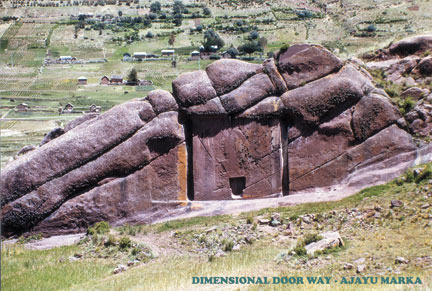
"What an amazing experience awaits the initiate who attends the Magical Mystery Tour of Peru and Easter Island with Mallku! Every day was so special that one could not imagine that the next day would be even more so!"--Robin Porter, California.
 "Peru is fortunate to have Mallku as their spiritual ambassador. He is a kind, gentle spirit; yet he is strong. He turneth away wrath. He has the patience of Job! He has wisdom beyond his age. Mallku KNOWS Peru. Mallku is a highly respected Shaman and author, but he is also an approachable human being. Now let's talk about Mallku's wife, Allana--a breath of fresh air. She is a beautiful woman, inside and out. She is friendly, confident, inspiring. Allana is a gifted dancer, singer, artist and musician. Mallku is a wealth of information on the sacred sites. For instance, without Mallku, we wouldn't have known the significance of what I call 'the keyhole in the great carved door.' In a huge carving on the side of a stone hill, there is a giant door flanked by two tall carved-out columns. At the bottom of the door is a big carved-out niche about six feet high in the shape of a thick T. In the first column to the right, you step inside and face inward and ask permission from Paccha Mama. Then you enter the thick T. First you kneel and conveniently place your hands at your sides on the stone. You lean a bit forward and your third eye chakra lands just so into a carved-out hole. Mmmmmm.connecting to universe..Then you stand up and make your body into a giant X with your legs and arms outstretched, filling the space. Now when you stand up, the carved-out hole matches up with your solar plexusmmmmmmmmWhen you have had your fill, you proceed to the next carved-out column and face outward, thanking Paccha Mama for her goodness and blessings."--Robin Porter, California. "Peru is fortunate to have Mallku as their spiritual ambassador. He is a kind, gentle spirit; yet he is strong. He turneth away wrath. He has the patience of Job! He has wisdom beyond his age. Mallku KNOWS Peru. Mallku is a highly respected Shaman and author, but he is also an approachable human being. Now let's talk about Mallku's wife, Allana--a breath of fresh air. She is a beautiful woman, inside and out. She is friendly, confident, inspiring. Allana is a gifted dancer, singer, artist and musician. Mallku is a wealth of information on the sacred sites. For instance, without Mallku, we wouldn't have known the significance of what I call 'the keyhole in the great carved door.' In a huge carving on the side of a stone hill, there is a giant door flanked by two tall carved-out columns. At the bottom of the door is a big carved-out niche about six feet high in the shape of a thick T. In the first column to the right, you step inside and face inward and ask permission from Paccha Mama. Then you enter the thick T. First you kneel and conveniently place your hands at your sides on the stone. You lean a bit forward and your third eye chakra lands just so into a carved-out hole. Mmmmmm.connecting to universe..Then you stand up and make your body into a giant X with your legs and arms outstretched, filling the space. Now when you stand up, the carved-out hole matches up with your solar plexusmmmmmmmmWhen you have had your fill, you proceed to the next carved-out column and face outward, thanking Paccha Mama for her goodness and blessings."--Robin Porter, California.
"Our trip to MP was a dream for me coming to life. Being afraid of heights in the past, I overcame this with Bob's help and seeing this fabulous city of MP that once was teaming with life, took my breath away in all its beauty. I am now able to look at any mtn or hill and BELIEVE I can climb that, not just look at it. This means everything. Bob says the people in our group, being such unique individuals, so spiritual in nature, are what made our trip wonderful. How wonderful it would be to take another trip with the same group. Our leaders of course are who put this whole fabulous trip together. Susan's great organizing skills, Mallku's brilliance in Peruvian history and sacred sites, Allana's grace and charm and her gift of music and dance, and Sean's amazing knowledge of life, history, and what may lie ahead for us all astounded us. How we would have liked to keep traveling and learining and loving each day never becoming saturated. Good God it was great! We would go again tomorrow anywhere with these people. Our choice would be the pyramids."--Ginny and Bob, Michigan.
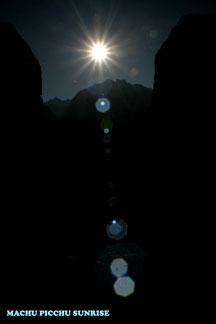
"I most liked that are tour guide was the incomparable Mallku. He went well beyond the calling of a tour guide by also being a great shaman. I appreciated his opinions, beliefs, thoughts, etc on the history of the Inka's and Machu Picchu. Mallku was able to herd our group into position for the exact moment of the sunrise at Machu Picchu during their winter solstice."--T.B., Oregon.
"For me, sharing this experience with a group of people that we got to know through the trials and excitement of this adventure was very powerful. Certainly there were many lovely sites to see. But the experience of the trip as a whole and the friendships that were forged is what I will remember most. The hotels were beyond our expectations. All of them had excellent breakfasts. It felt very European to us. We really enjoyed how comfortable all of the beds were. The food at all of the suggested restaurants was very good. In general, all the sites we visited were very impressive. Mallku gave us a good spiritual perspective as well as historical information on each site. We really enjoyed the ceremonies that we did at each site with Mallku. I don’t always feel energy very easily. However, there were several occasions where I was almost overcome with emotion. The hike up into Macchu Picchu was the most memorable. It was almost a sense of coming home. The energy of being in the mountains was very powerful."--D.W., Illinois.
"We were guided through some powerful meditations. We experienced vortexes, orbs, even a crazy light show in the sky and a UFO while at Amantani Island in Lake Titicaca. I can't even begin to write about all the wonderful ceremonies we experienced! We had ceremonies at the crystal cave at Macchu Piccu, had a great time experiencing the power plant Wachuma at The Water Temple at Tipon, etc. I learned that I need to trust myself and relax more. It was so nice to have everything pre-arranged: lodging, transportation, tours, some of the meals. Very smooth. Good use of email to update info. I feel so 'at peace and joyful' despite coming back to my hectic job and a huge pile of work to catch up on. And I have a bunch of new friends! I would highly recommend the tour to others. DO IT!" --Robin Porter, California.
"My favorite hotel was in the Sacred Valley of Peru. The stone path to our room led past plantings of beautiful flowers and a waterfall. French doors opened onto a small private patio with bench. The shower and tub with hot water was so welcome at night. Enchanting! I adored the bistro in Macchu Piccu owned by a Frenchman called Indio Felix. We took pictures of the food because it was so pretty. Large portions of healthy, yummy food."--Robin Porter, California.
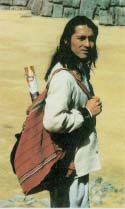 "My trip to Peru was
life-changing and I am truly grateful to Mallku who led the tour.
He is a Master Teacher and it was a privilege to share shamanism
with him. It was a grand time being at Machu Picchu during the
Solstice. I will never view future Solstices the same, because of
Mallku's teachings. Mallku was an expert at responding to the
energy of the group and was always modifying his plans to better
suit our needs. I was pleasantly surprised by the lodgings and
food. The rooms were great and the hotel staff generally very kind
and helpful. It is impossible to describe my favorite day, my
favorite activity. I thought Day #1 was the best, but each day got
even better. culminating in my trip of a lifetime. Thank you for
providing such a well organized, spiritual tour. It was described
in precise detail on the website, a history lesson in itself, and I
will always be grateful for this transforming trip." --Dhyana, New
York. "My trip to Peru was
life-changing and I am truly grateful to Mallku who led the tour.
He is a Master Teacher and it was a privilege to share shamanism
with him. It was a grand time being at Machu Picchu during the
Solstice. I will never view future Solstices the same, because of
Mallku's teachings. Mallku was an expert at responding to the
energy of the group and was always modifying his plans to better
suit our needs. I was pleasantly surprised by the lodgings and
food. The rooms were great and the hotel staff generally very kind
and helpful. It is impossible to describe my favorite day, my
favorite activity. I thought Day #1 was the best, but each day got
even better. culminating in my trip of a lifetime. Thank you for
providing such a well organized, spiritual tour. It was described
in precise detail on the website, a history lesson in itself, and I
will always be grateful for this transforming trip." --Dhyana, New
York.
"The tour and Mallku was outstanding and very educational. Mallku did a magnificent job of explaining all the historical and sacred practices in all the places we visited. I believe we could not have had a better guide and shaman. I immensely enjoyed the ceremonies and meditations which brought me much fulfillment and many answers that I have been questioning. Divine Travels did a marvelous job arranging all the reservations and travels. I certainly would recommend them to my friends. The whole process and trip experience was awesome and very rewarding to me. Thanks again for all the work you put into it Susan." --Diane Dropik, California.
 "Mallku is marvelous and I truly loved all my time with him and benefited greatly from his ceremonies. All the places he took us were indeed sacred and amazing and I truly loved the trip." --W.G., Arizona. "Mallku is marvelous and I truly loved all my time with him and benefited greatly from his ceremonies. All the places he took us were indeed sacred and amazing and I truly loved the trip." --W.G., Arizona.
"Overall, the tour was
spiritually uplifting and life-enhancing. It was very nice. Mallku
was great. The Inkan ceremonies made the whole trip more
meaningful. I enjoyed the other tour participants, and it felt like
a big family. My favorite aspects of the tour were Machu Picchu and
the firewalk. --Ryan West, Washington State.
"The people in the group were wonderful. We worked hard to find a spiritual path and seek new knowledge wherever we went. I loved the tour. I truly mean I loved the tour. I had a wonderful time. The people, the food, and the sights were all that I hoped for and more." --J.U., Hawaii.
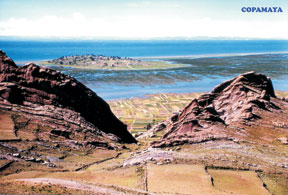
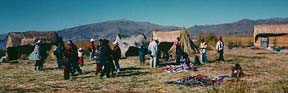
"We are very pleased to hear that Mallku felt this trip to be such a success. We thought and felt so as well. The ceremony and spiritual aspects of the tour were fabulous. More than we ever expected. It is so sad that the Peruvian government is going to outlaw the ceremonies in the national sites, we feel very blessed to be there at a time that we could have ceremony in most places. The extras that Mallku and Alanna lined up for us were wonderful - lunch in the community of Copamaya, stopping at the pottery shop, silversmiths and other local places. They are obviously well known and the business owners appreciate them. The other shamans and helpers were wonderful also, Amaru, Wilbert and Carlos. Again, we were so pleased with our trip and all that accompanied it. It was more than we anticipated and we learned so much about ourselves, the Andes and Peru. We are greatfull to have this opportunity and Thank You again for putting this together. May we learn to live more and more the freedom and sweetness that we prayed for everyday."--Curt Schneider and Cathy Hume, Oregon.
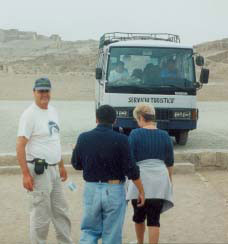 "I enjoyed re-visiting the power places and re-engaging in Mallku's spiritual ceremonies. This second time, the experiences were deeper, the connections to Pachamama and Viracoccha more clear and the transformations in life more dramatic. I carry within my heart the tender feelings of connection with the dimensions of these divine souls; and the connections seem more permanent. Now, I own the experience, rather than just tasting what is available. The child of the Sun has returned home and she is very, very happy."--T.M.S., Iowa. "I enjoyed re-visiting the power places and re-engaging in Mallku's spiritual ceremonies. This second time, the experiences were deeper, the connections to Pachamama and Viracoccha more clear and the transformations in life more dramatic. I carry within my heart the tender feelings of connection with the dimensions of these divine souls; and the connections seem more permanent. Now, I own the experience, rather than just tasting what is available. The child of the Sun has returned home and she is very, very happy."--T.M.S., Iowa.
"Mallku opened up the portals of these new dimensions and helped me become established on that inner spiritual level. He was supportive of my making connections with the group from a distance when I could not be with them for other reasons. He was alert, open, respectful and kind at all times. If an experience was not appropriate for my nervous system, he would discourage me from attending, at the same time helping me feel comfortable with the decision. He is a good guide on such pilgrimages. I gained a lot on every level. The sacred sites stirred deep memories within my heart and mind. At times the simplicity and joy of the sacred place overwhelmed my heart; at other times they challenged me to grow. At no time did I take the place for granted; at no time did I feel empty or neutral. Each place pulled me out of my relative boundaries and jump-started my evolution again and again and again. I am not the same, nor will I ever be the same after this journey. It may take a little time to fully digest the transformations that occurred, but I know I am in a better place now for having gone on the tour."--T.M.S., Iowa.
"I especially loved the Temples to the Sun and Moon, Pisac, Macchu Picchu and the Dimensional Portal near Puno. Sacsayuaman left me deeply moved. So much light, so little time to digest the energy of the power. I needed more time at each place in order to integrate more thoroughly the frequencies generated by each place. I also wish we had more time for longer ceremonies at these sacred places.We had just a little taste; I want more and more and more! Just like a child, eh?"--T.M.S., Iowa.
'The sacred circles allowed us to hear and know one another. I'm not sure if we told the truth in those circles or just spoke something acceptable to others as we knew 23 others were listening to our "story". But some kernal of truth still comes through. I would have enjoyed hearing more of other's experiences at the sites. I think we needed to discuss our experiences. The guided meditations were fantastic. If one just remained surrendered and open, dimensions opened on many, many levels. Mallku has a way of checking on each one of us, helping us develop our inner spirituality to its maximum. It's just a matter of trust in the Shaman."--T.M.S., Iowa.
"Two come to mind rather quickly and I am not sure why they are not in my "highlights" list. Chinchero came first. As we walked along the trail I couldn't take it all in! Although other places had more spectacular things to see, I felt comfortable and at home there, even though it was my first trip to South America."--N.B., Oregon
"During the meditation I felt very emotional and on the verge of tears. A sense of belonging, mixed with sadness came over me. I don't know why, but it had a huge impact on me and perhaps gave me the mindset that I kept for the next few weeks."--N.B., Oregon
 "Moray was also so very impactful! As we meditated and I listened to Mallku's voice and movements, faces came across my visual imagery in rapid succession. Almost all looked to be from the Andean culture with except for one--it was that of a Spanish conquistador! I felt as I was torn between two groups of people and for the first time that I can recall--vivid colors dominated this imagery!"--N.B., Oregon. "Moray was also so very impactful! As we meditated and I listened to Mallku's voice and movements, faces came across my visual imagery in rapid succession. Almost all looked to be from the Andean culture with except for one--it was that of a Spanish conquistador! I felt as I was torn between two groups of people and for the first time that I can recall--vivid colors dominated this imagery!"--N.B., Oregon.
"During the tour, I learned how to better balance the energy generated by each power place. At first it was overwhelming; eventually I could handle it better. Many personal instructions focused on balancing the energy, of becoming more centered as frequencies shifted drastically. I learned to 'ride the wave' rather than get lost in the froth of the wave. Nice."--T.M.S., Iowa.
"The tour was well organized. Susan's organizing power; Mallku's attending to details every hour of every day; the extra staff who cared for us as needed, all added to the creation of a delightful tour. One of my favorite memories will be Mallku waiting half-way to wherever we were going, counting as each one passed, "twelve, thirteen, fourteen", making sure we all were present and accounted for. We all learned to look after each other when during day one a fellow got left behind at a pit stop. Never happened again. The fellow in question joined us by the evening. He had the phone numbers that had been provided us in case anything happened. Mallku and Susan thought in advance of nearly everything that might happen."--T.M.S., Iowa.
"Hotels were alerted before we arrived; restaurants were ready to serve 26 people; tourist places were open; buses available; and despite the riots of Cusco, we managed to accomplish our goal of celebrating the lunar eclipse and still escape crazy Cusco for a soothing ride to Puno. That was a coup on the part of excellent organizers. Well done."--T.M.S., Iowa.
"'Wow,' 'Powerful,' 'Soul changing' and 'Eye opening' are the descriptive words that come immediately to my mind when I think about my amazing experience with Mallku and Linda! Sunrise at Machu Picchu on the June Solstice comes to mind first! It was spectacular! After spending time touring, meditating and listening to Mallku for several days prior, for whatever reason, watching that sun rise over the mountains was quite emotional for me! Festival of the Sun in Cuzco was marvelous! The story that was told and the colorful actors/dancers were so very entertaining. We had a fabulous place to view the pageantry.--N.B., Oregon.
"Seven years ago, after my first tour with Mallku, I knew I had to return, that there was more to gain from this most spiritual shaman. This time, I feel complete. Mallku was able to bring me to fulfillment while simultaneously caring for the needs of those who were with him for the first time. I don't think anyone felt a loss, only gain. No one had a feeling of receiving less, rather each one experienced the growth of spiritual values according to their own understanding of those values. My spiritual transformations have to do with knowing truly who I am, how I connect to the world, and what I can do to optimize change on the spiritual level. New attitudes, new perspectives, a new joy that transcends the relative. I don't want anymore; I simply feel full. I am living the fullness of life. Living in the light of God."--T.M.S., Iowa.
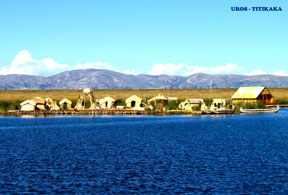
"Our spiritual journey to Inkan Power Places and the indepth explanation of Inkan culture and belief system. We saw so much and experienced the wonders of this ancient land. Mallku is a giften Shaman with a true depth of understanding of the energetic relationship between all of the elements, especially Mother Earth. Clearly, sunrise on Solstice morning at Machu Picchu was a highlight, as was the fascinating visit to the "Floating Island". The incredible celebration of Solstice in Cusco was magical and beyond description."--E.B., Colorado.
"The Peru trip was amazing! Mallku was truly a deep and incredible guide and teacher. overall, the trip experience was absolutely life-changing!! Thank you for all that you did to put it together for us."--L.B., Colorado.
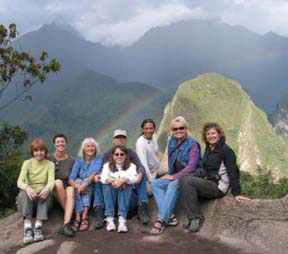
"Don't hesitate. This is a true spiritual pilgrimage; something that so many of us crave and so few of us get. Here it is; all yours. All you need do is sign up and enjoy. Oh, and leave lots of space in your luggage; Mallku takes us to great shopping spots."--T.M.S., Iowa.
"Machu Picchu was a revelation. I loved Mallku and his teachings, ceremonies, and celebrations. Meditations were really powerful and life-changing."--R.B.N., Connecticut.
"I just want to thank you, Susan, for all you did to make this trip happen. It's not easy to care for people on a pilgrimage; yet you managed to make the care look so effortless. Our attention was not taken away from our spiritual goals; and that is the sign of a great tour guide. The balance of spiritual experience, entertainment, and shopping kept us all happy and focused without strain. I hope more and more can take advantage of this tour. It is a gem. I hope more will come for a second tour with Mallku as I did. The second time is far more powerful than the first. Who knows, maybe there should be a series of tours with Mallku....something I don't think he has even thought of." --T.M.S., Iowa.
|
|
TOUR
ITINERARY:
ANDEAN MASTER PATH
YOU MAY REQUEST OTHER DATES
AT THIS EMAIL ADDRESS:
You can be part of a once-in-a-lifetime adventure: FULL MOON in the Andes! Featuring amazing shamanic Andean guide
MALLKU.
Space is very
limited on this tour. Register now to secure your
spot.
DAY 1:
HOME - Flight to CUSCO (Pick up at airport by our team guide)
Reception & transportation to the hotel. Resting for easy acclimation.
Overnight
in Cusco.
(FLIGHT NOT INCLUDED IN TOUR FEE)
PLEASE REQUEST OTHER DATES
AT THIS EMAIL ADDRESS:
Flight from home to Cusco, Peru (Airport Code CUZ). Please book a flight to Lima that transfers to Cusco on DAY 1. If your international flight does not allow you to arrive in time to fly to Cusco on DAY 1, then please arrive one day early in Lima and stay overnight in Lima at an airport hotel, such as Holiday Inn Lima Airport or Costa del Sol Wyndham Lima Airport. Then take a flight to Cusco in the morning.
You will be met at Cusco airport and transported to your hotel. If you wish to arrive one or more days earlier, to rest and acclimatize the high altitude in Cusco (11,152 feet above sea level), before starting your tour, please book extra hotel night(s), which is available on the REGISTRATION
FORM.
No matter what date or time you arrive, as long as you are staying in the hotel that we have booked for you, you will be picked up at the Cusco airport and transferred to hotel. Overnight Cusco.
DAY 2:
INKA MAGIC CENTERS OF CUSCO (Led by MALLKU)
Today we discover the sacred centers near Cusco that will allow us to work with the energies of the 4 elements. Tambomachay, Puka Pukara, Q'enqo and Saqsaywaman are the energetic centers that welcome us. The Inka sages left a large amount of codes and internal activators in all these centers for human evolution.
At the right time return to Cusco. Overnight in Cusco.
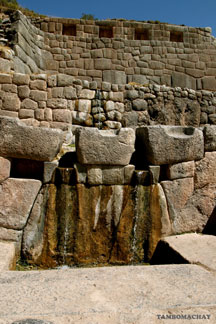 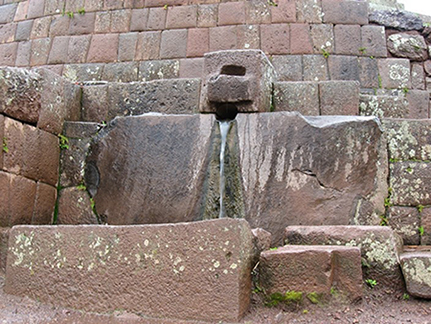
Tambomachay (possibly from Quechua Tampu: inn, guest house, mach'ay cave, or machay drunkenness, to get drunk or "spindle with thread" is an archaeological site associated with the Inca Empire, located near Cusco. An alternate Spanish name is El Baño del Inca ("the bath of the Inca").
It consists of a series of aqueducts, canals, and waterfalls that run through terraced rocks. It is situated near springs such as the one called Timpuc Puquiu, a boiling spring on the northern bank of the Timpuc River and the spring near Huaylla Cocha community. These natural springs were channeled through three waterfalls that still flow today.
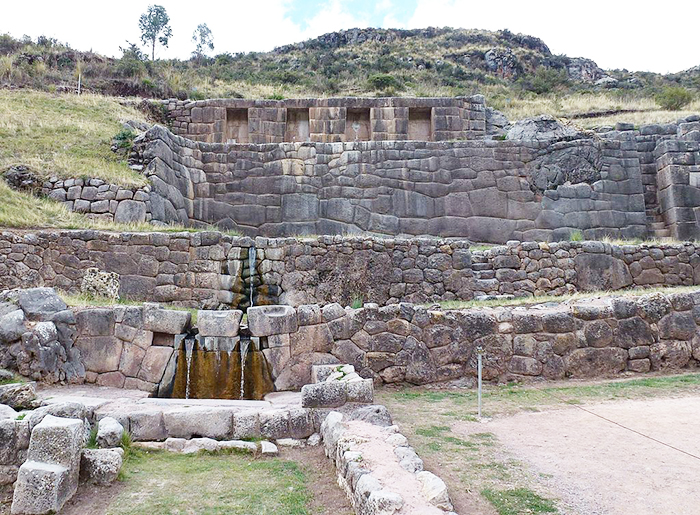
The function of the site is uncertain. It could have also served a religious function since sacred water fountains were found almost all of major Incan temples such as Pisac, Ollantaytambo, and Machu Picchu. There are sources that refer to Tambomachay as one of the nine ceques (ritual pathways) built along the Road of Antisuyu, describing it as an Incan house where sacrifices were also made.
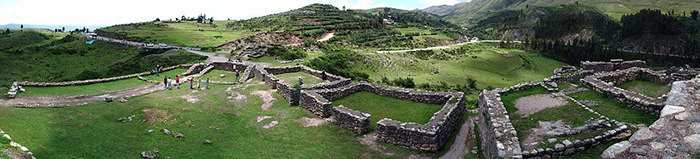
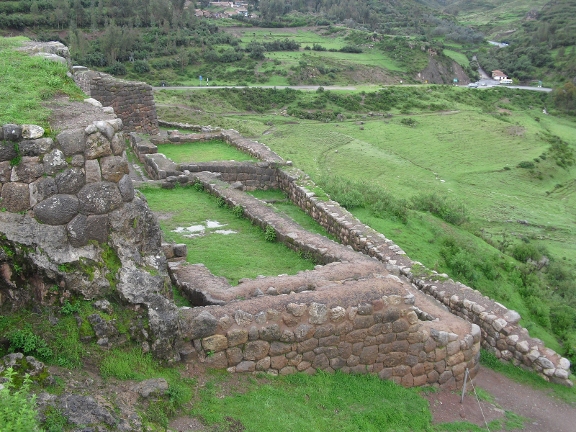
Puka Pukara (Red Fortress): There is some debate over what Puka Pukara's real function was when the Incan empire was still thriving. As stated above, it was at least partially a military base, and, since it was on such a major road and overlooking so many important spots, it was a very good place to spot people causing trouble. Officials could have used it as a checkpoint on the road, stopping those who looked suspicious from travelling any further into the empire where they could potentially wreak havoc. It could have served as a stop for military groups travelling nearby, too. Another theory is that it was a place of rest for hunters and weary travelers, as well as Incan nobles, due to all of its luxurious baths, canals, plazas, fountains, and separate rooms.
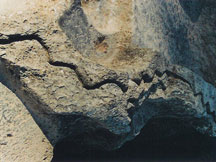
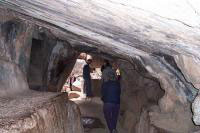
Q'enqo (Sacred Place of the Puma: Q'enqo means
labyrinth or zigzag. Located 2 km from Cusco, this temple dedicated
to Mother Earth is a unique center of worship and for ceremonies.
It has numerous ceremonial carvings, holes and canals cut into the
rock. One of its features is a semi-natural underground chamber.
Limestone formation intricately carved with depictions of mythical
beings, as well as winding underground passageways and semicircular
amphitheater.
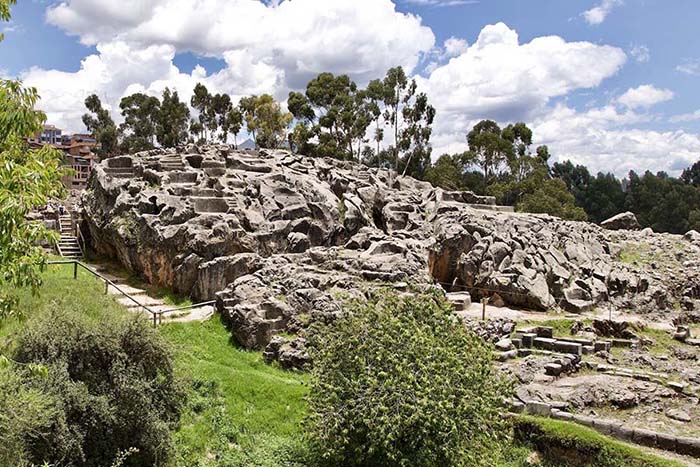
Believed to have been used for worshipping the Earth.
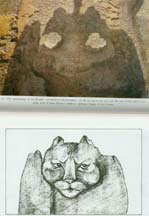
Temple of the Living Light ceremonial altar and main spiritual
center. Dedicated to the Puma, the vibrant vortexes are some of the
most powerful for initiates, plus the mysterious Amaru Machay--Cave
of the Serpent. Our specialist
guide will show to you the magic of the ancestors and the esoteric
wisdom of the heavens where astronomy was the base to understand a
practical life as a way of meditation.
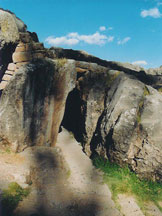 
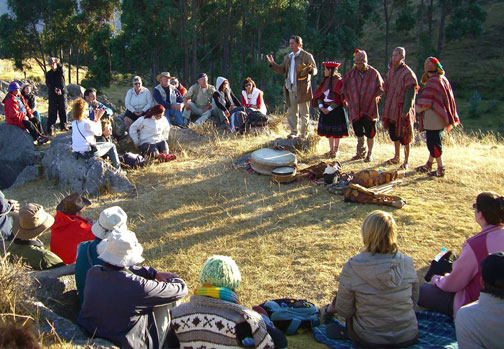
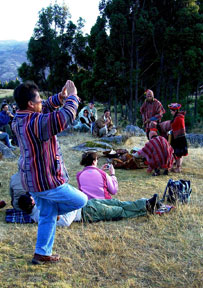 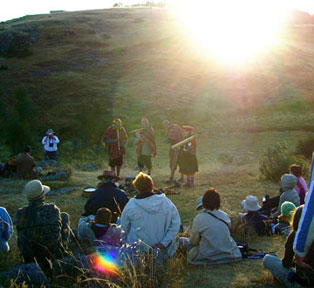
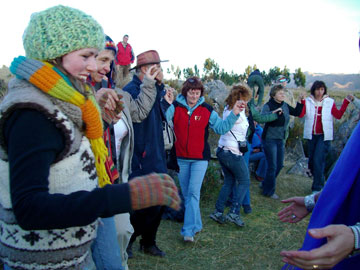
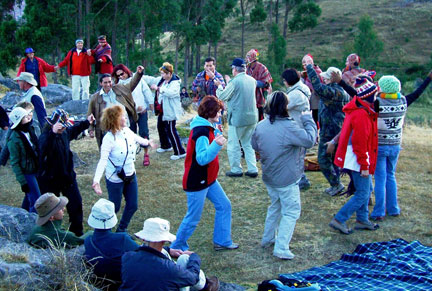
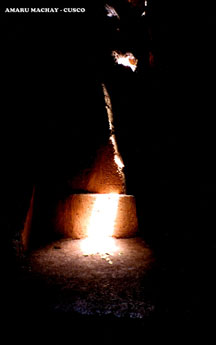 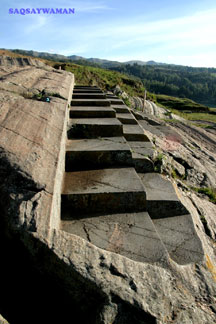
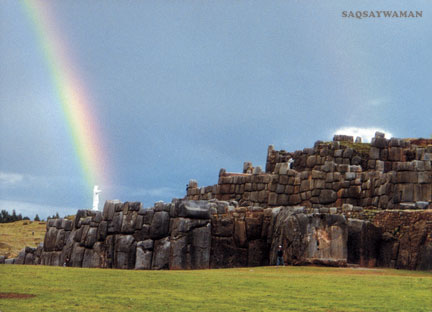
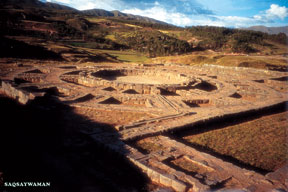
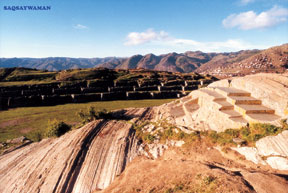
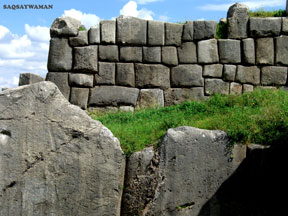
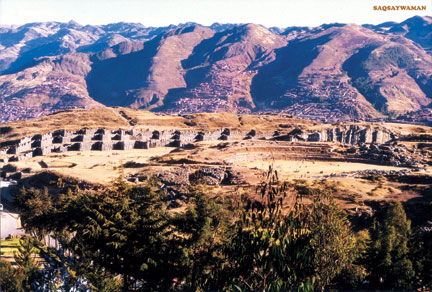
Saqsaywaman (Sacsayhuaman): a huge, stunning site which holds the great house of the Sun, where the head of the Puma of Cusco resides. Its megalithic, zigzag stone walls were pieced together with amazing skill, drawing the Snake and other Andean symbols, like a lightening bolt across a great field. Saqsaywaman is located one kilometers from the city of Cusco, the immense walls of the complex made up of huge stones distributed in a zigzag pattern in three platforms. Together with the city of Cusco, this monumental complex is one of the wonders of the world. This huge construction was planned and built by Andean masters. The Inkas called it the House of the Sun. The construction, which is made up of three platforms one on top of the other, was one of the most important spiritual centers at the Andes. Inka Pachakuti and other spiritual leaders considered this place as the most important temple dedicated to the Sun, the Moon and the Stars.
DAY 3:
MACHU PIJCHU (Led by team guide)
Transfer to the station and travel by train to the village of Aguas Calientes, from where we begin the visit to the Crystal City of Machu Pijchu. Discovery of Machu Pijchu, The "City Crystal" is located on a site of great energy power. The sages recall that this place was dedicated to initiatory practices intended to receive higher teachings. All these inner experiences bring self-confidence and an enlightened vision of the meaning of one's own life. This connection will open you to the magic of the city and its solar temples.
Early in the morning we will take the train ride to the village of Aguas Calientes. We will then take the bus and visit the famed city of Machu Pijchu, named by Mallku as the Crystal City, the Rainbow City, the City of the Kondor and the Hummingbird, the City of Peace, and the City of Light.
In the afternoon return to Cusco by train and bus. Overnight in Cusco.

We enter Machu Pijchu to take part in a ceremony for a deeper journey into the inner path to gain confidence in our souls and our unique purpose. The solstice creates a cosmic wave and light influence into our planet and we will have the chance to celebrate here in Machu Pijchu sending light and transforming our own path in a solar experience. We return to Cusco on an afternoon bus and train. Overnight in the "navel of the world."
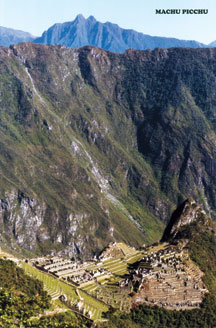 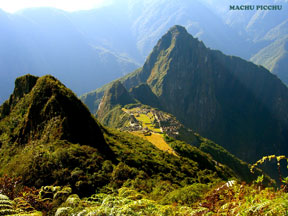
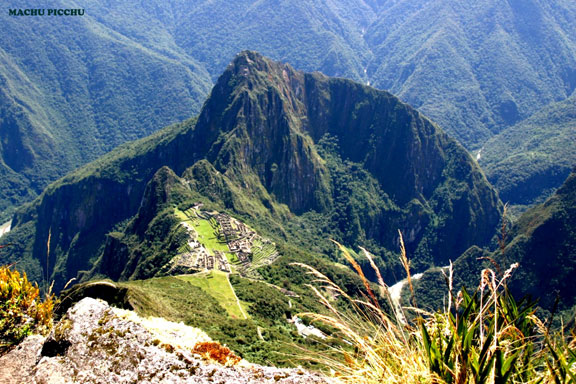
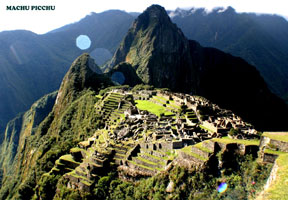
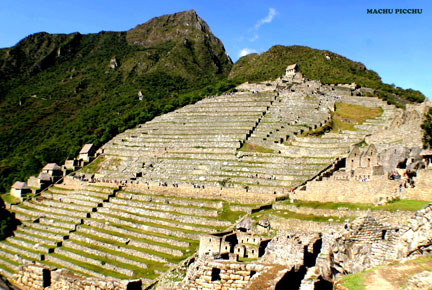
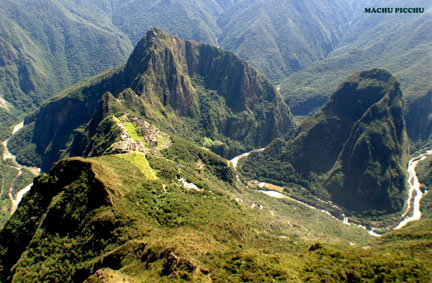
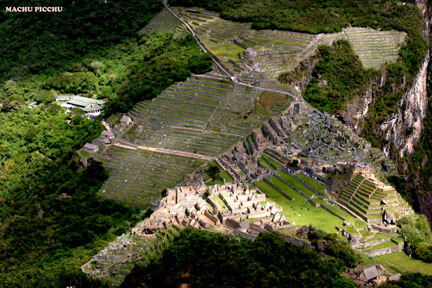
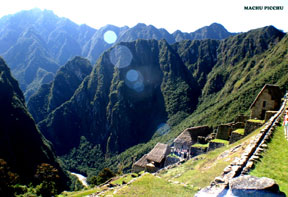
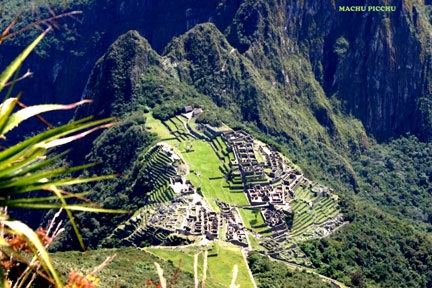
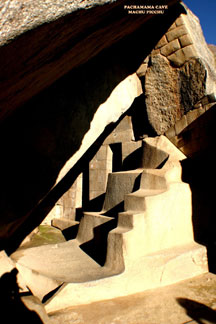
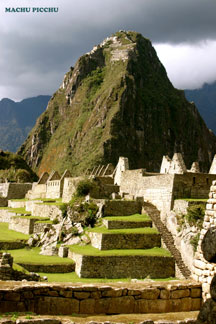
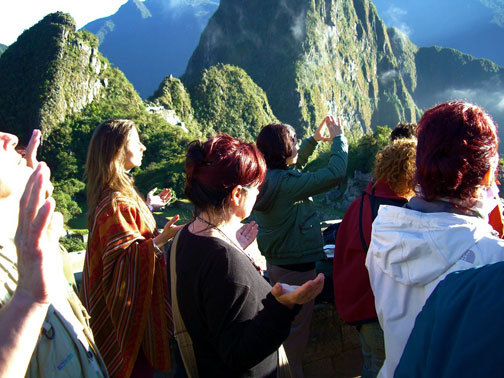
Machu Picchu: The legendary beauty of this magnificent city defies description. There are many trails and power sites to explore here, and we will have ample opportunity for ceremony to open to a deeper experience of the intrinsic magic of this amazing city and temples. Guided visit with esoteric insights on the various temples and power spots. Participate in inspiring spiritual ceremonies to enhance your connection with your divine self--a transpersonal, transformational journey within.
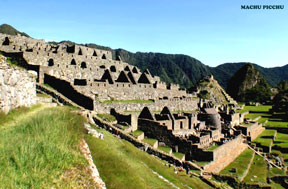 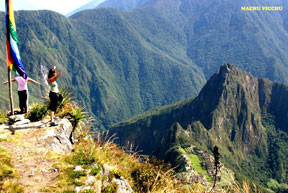
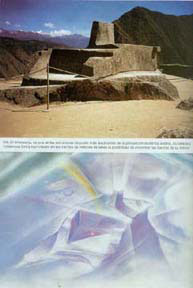
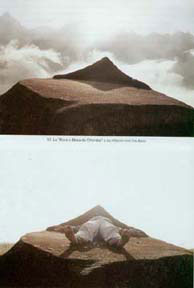
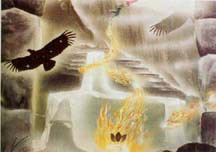
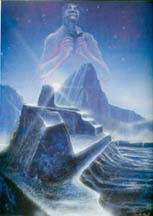
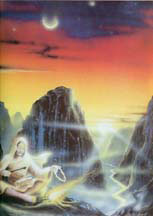
Mystical Paintings: Enjoy the amazing, inspiring, visionary
art published in our guide Mallku's books. These awesome, mystical
paintings of Machu Picchu are below and as you scroll
down:
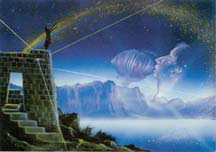 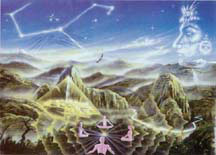
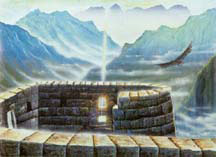
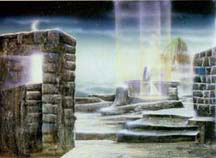
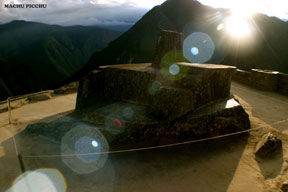 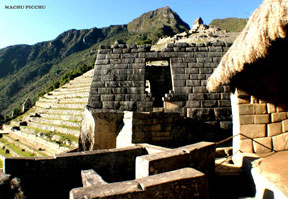
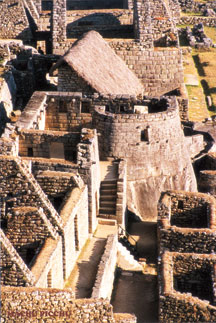 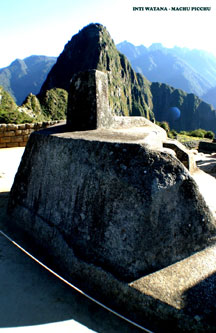
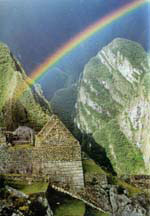
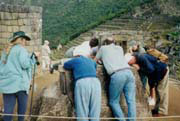 Machu Picchu: the "Lost City of the Inkas," "City of Light for Initiates," An ancient site fed by grids of powerful natural energies patterned by surrounding mountains and extensive underground tunnels. Machu Picchu: the "Lost City of the Inkas," "City of Light for Initiates," An ancient site fed by grids of powerful natural energies patterned by surrounding mountains and extensive underground tunnels.
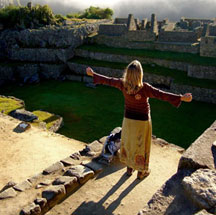
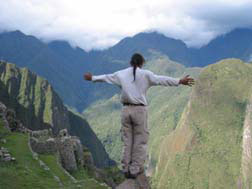
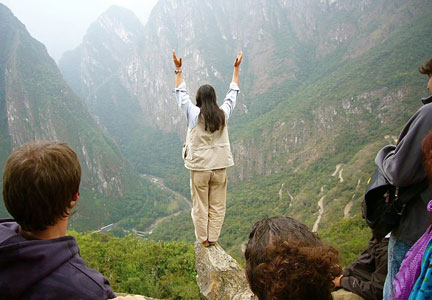
Shamanic belief is that for millennia this site served as an initiatory center for higher learning. The sanctuary covers many square kilometers constructed of mortared terraces and connected by endless stairs carved from solid rock all around the mountains. Throughout the ages, the sheltered temple sights, geophysically conducive atmospheres were used for ritual and mind-altering experiences. Shamanic legend says that touching one's forehead to the Intiwantana Stone opens one's vision into the Spirit World. Tune into Wakas (sacred spots) of individual rocks and boulders. Experience the classic "magical flight" of shamanic ecstasy.
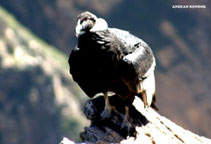 Historical Conjecture: Rediscovered by Hiram Bingham in 1911,
Machu Picchu was unknown to the Christians. Its reason for
existence remains under debate. Some argue it was built and
populated by the family of one Inka ruler, Pachakuti; others have
proposed the principal function of Machu Picchu was to maintain a
reliable supply of coca leaves for the priests and royals of Cusco.
Bingham fostered the school of thought that the city existed
primarily for strategic and defensive purposes, but other findings
support the hypothesis that Machu Picchu was a university where the
children of the leaders of other Andean cultures conquered by the
Inkas were taken to Machu Picchu to be taught the Inka way of life.
At any rate, as we wander through the maze of empty plazas,
chambers and dwellings saddled atop steep mountainsides, we will be
unable to resist our own speculations at the impenetrable mystery
of these stones. Historical Conjecture: Rediscovered by Hiram Bingham in 1911,
Machu Picchu was unknown to the Christians. Its reason for
existence remains under debate. Some argue it was built and
populated by the family of one Inka ruler, Pachakuti; others have
proposed the principal function of Machu Picchu was to maintain a
reliable supply of coca leaves for the priests and royals of Cusco.
Bingham fostered the school of thought that the city existed
primarily for strategic and defensive purposes, but other findings
support the hypothesis that Machu Picchu was a university where the
children of the leaders of other Andean cultures conquered by the
Inkas were taken to Machu Picchu to be taught the Inka way of life.
At any rate, as we wander through the maze of empty plazas,
chambers and dwellings saddled atop steep mountainsides, we will be
unable to resist our own speculations at the impenetrable mystery
of these stones.
Today it is a
Historic National Sanctuary, protected by the Peruvian Government,
that tries to conserve the geological formations and archaeological
remains inside the Sanctuary, besides protecting its flora, fauna
and landscape's beauty. The whole park has an extension of 80,535
acres (32,592 hectares; 125.83 mile).
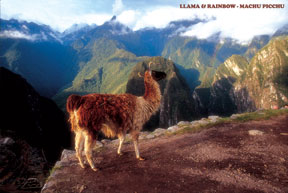 
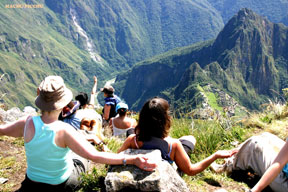 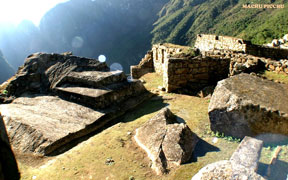
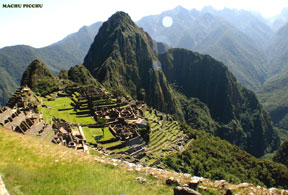 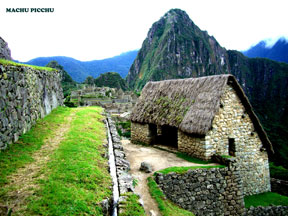
 Locale and
Climate: Machu Picchu (the Inkan City) is located on kilometer 112
(70 miles) of the Cusco-Quillabamba railway; the train station is
now in Aguas Calientes and lies at an altitude of 2,000 meters
(6,560 feet). From that station there are buses in order to get to
South-America's most famous Archaeological Group that is found at
an average altitude of 2,450 meters (8,038 feet). The climate in
that sector has also some characteristics that are found all over
the region; thus, only two well defined seasons are distinguished:
the rainy season in the area goes between November to April, and
the dry season from May to October. Machu Picchu is near the
commencement of the Cusquenian Amazonian Jungle, so the chance of
having rains or showers is possible any time of the year. In the
hottest days it is possible to get even about 26° Celsius (78.8°
Fahrenheit), while that in the coldest early mornings in June and
July the temperature may drop to 5° C.; the average annual
temperature is 16 degrees Celsius. Between May to August the
weather is beautiful because the skies are nearly always blue and
clear. Locale and
Climate: Machu Picchu (the Inkan City) is located on kilometer 112
(70 miles) of the Cusco-Quillabamba railway; the train station is
now in Aguas Calientes and lies at an altitude of 2,000 meters
(6,560 feet). From that station there are buses in order to get to
South-America's most famous Archaeological Group that is found at
an average altitude of 2,450 meters (8,038 feet). The climate in
that sector has also some characteristics that are found all over
the region; thus, only two well defined seasons are distinguished:
the rainy season in the area goes between November to April, and
the dry season from May to October. Machu Picchu is near the
commencement of the Cusquenian Amazonian Jungle, so the chance of
having rains or showers is possible any time of the year. In the
hottest days it is possible to get even about 26° Celsius (78.8°
Fahrenheit), while that in the coldest early mornings in June and
July the temperature may drop to 5° C.; the average annual
temperature is 16 degrees Celsius. Between May to August the
weather is beautiful because the skies are nearly always blue and
clear.
Geology: The Machu Picchu Historic National Sanctuary is found
over a great granite orogenic structure baptized by Dr. Isaiah
Bowman as the "Vilcabamba Batholith" that outcrops over about 400
km (154 mile). Its formation belongs in the scale of geological
time to the Paleozoic or Inferior Primary and may have an
approximate age of 250 million years.
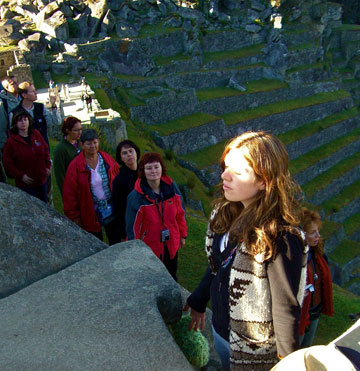 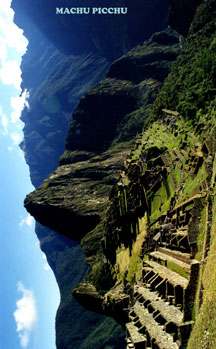
Origin of Name: Machu Picchu (like most of the Quechua names of
towns and different sites in the region) is a compound word that
comes from machu = old or ancient, and picchu = peak or mountain;
therefore, Machu Picchu is translated as "Old Mountain." The famous
mountain that is seen in front, and appears in most of the
classical views of the site is named Wayna Picchu (Young Mountain).
Unfortunately the original names of the mentioned sectors are lost,
Machu Picchu, Wayna Picchu and some other proper names used today
are contemporary ones; ascribed probably by farmers living in the
region before Bingham's arrival. However, according to studies
about some XVI century documents, the original name of the whole
area might be "Picchu."
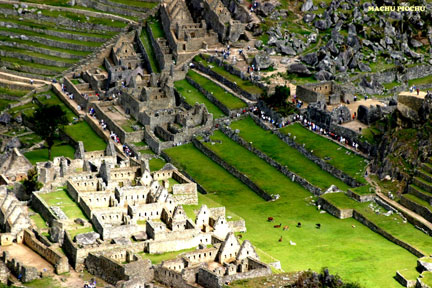
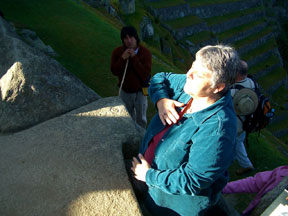 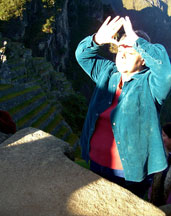
History: It is known that Hiram Bingham, a descendant of
missionaries, was the man who rediscovered Machu Picchu for the
contemporary world and modern science. He was a North-American
historian born in Honolulu, Hawaii; who in 1907 taught the
South-American History and Geography course in Yale University.
Later he was chosen as delegate of his country to the First
Pan-American Scientific Congress carried out in Chile in 1908. By
that epoch he began his activities as explorer taking a horseback
journey from Caracas to Bogota, following the Simon Bolivar's way.
Then he followed the old colonial trade way from Buenos Aires to
Lima, arriving to this Andean zone in 1909; it is in that year when
from Abancay he started with his first exploration towards
Choquekirau, trying to find the last Inkan Capital. By that time
many myths had been created about the possibility of finding the
"Inkas' treasures" that according to tradition had been taken by
Manko Inka in his retreat to Willkapampa (willka = sacred, pampa =
plain; its Spanish form is "Vilcabamba"); thus it was so common by
that epoch to find treasure hunters willing to get to this last
Inkas' dwelling. That same intention moved Bingham to study
chronicles and even to visit Spanish archives, and subsequently in
1911 to come back to Peru with the aim of performing studies of
geology and botany, and for sure, also in order to try finding
Willkapampa.
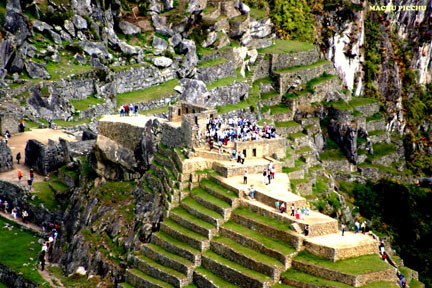
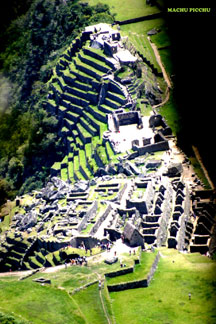 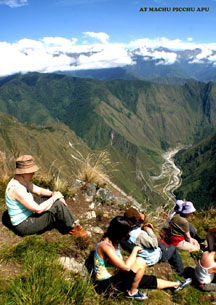
In
Cusco, Albert Giesecke, a compatriot of his and rector of the local
University had put him in touch with Braulio Polo y la Borda, owner
of Mandor. That local landlord told Bingham that on the hill in
front of his property there were ancient constructions covered by
vegetation where cattle were frequently lost; and moreover, he
introduced Bingham to Eduardo Lizarraga, a farmland renter living
in the area since the 70s of the 19th century, who had seen the
buildings. On July 23th, 1911 Bingham showed up in Mandor along
with a policeman, Sergeant Carrasco, who escorted him by order of
Cusco's Prefect Juan Jose Nunez. They found in his hut the peasant
Melchor Arteaga who told Bingham about the existence of two Inkan
sites named Machu Picchu and Wayna Picchu; that same peasant was
hired by Bingham to be the guide in order to get to the Inkan City.
The next day, after examining the field they decided to climb up.
After noon they arrived at another hut where they found Anacleto
Alvarez and Toribio Recharte; they were two humble peasants who
along with their families lived in the area and cultivated the
pre-Hispanic farming terraces. After a short break, they provided a
boy as the guide for Bingham in order to have a first look of the
Inkan buildings that were completely covered with entangled
vegetation. That was how Bingham, at 35 years old, stumbled onto
Machu Picchu; a fortuitous happening that made manifest a great
"discovery."
Almost immediately after his first exploration, he went
back to the USA looking for economic support that was granted to
him by the Yale University and the National Geographic Society.
Subsequently, the Peruvian government in Lima facing Bingham's
request in order to execute works in Machu Picchu, by means of law
given on October 31th, 1912, authorized him to carry out his
projected works. Besides, according to the fourth article of that
authorization Bingham could freely take out of the country all the
obtained pieces during his explorations, but with commitment of
giving them back to Peru's simple petition. Authorization in the
name of "international etiquette" that infringed some legal rules
and caused irreparable damage to Peru's cultural
heritage.
DAY 4:
TEMPLE OF WATER (Led by MALLKU)
Visit to the Water Temple of Tipon, where you will have a sweet and nourishing experience for your soul. The water that flows along the terraces, towards the waterfalls and the fountains comes from the energy sources of the sacred mountain Pachatusan. The site is known to have produced phenomenal healings. The healing ritual that you will follow in this place will be marked by a great transformation.
Today we work the energies for purification at the Temple of Water. Personal cleansing and healing action for the planet. The Inka sages honored all the elements and this journey will be completed in the Temple to honor the Water in Tipon. Beautiful Inka Center that allows us to carry out energy and personal healing work. This ancestral engineering center not only proposed structures to change the conditions for improving food, but also the frequencies of the human being.
Overnight in Cusco.
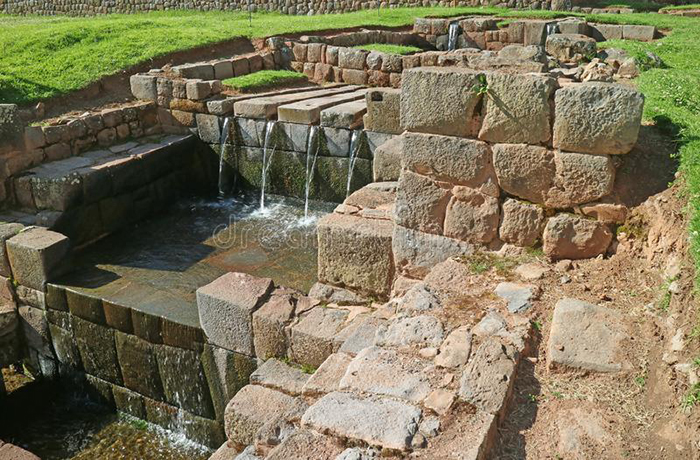
The Archaeological Park of Tipon: Tipon is an ancient agricultural site with many terraces and an intricate irrigation system that runs along the Temple of the Water. Tipon, a place of great water fountains, is one of the most important architectural complexes found in Cusco vicinity. This old site is located 23 km. Southeast of the Inka capital at a height of 3,600 meters above sea level; the highest area of the park is found at the pass of Ranraq'asa above 3,900 meters. It belongs to the district of Oropesa, province of Quispicanchis in Cusco.
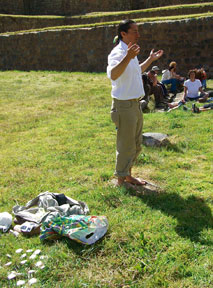 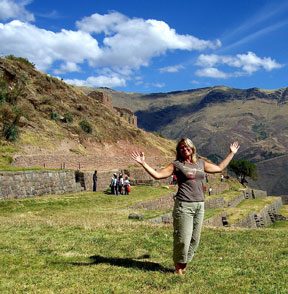
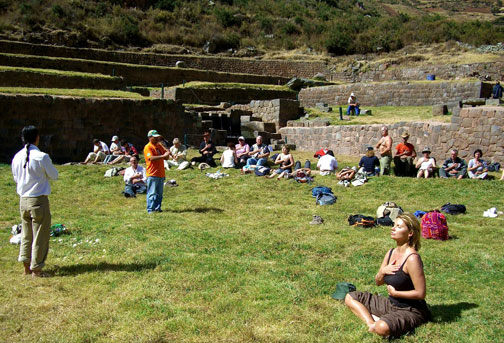
Historian Luis Antonio Pardo says the real name of Tipon may come from the Quechua word Timpuj which means "to be boiling", and it relates to the water flowing out of the fountains as if the liquid was boiling. This name was recently made up since the original name is not known.
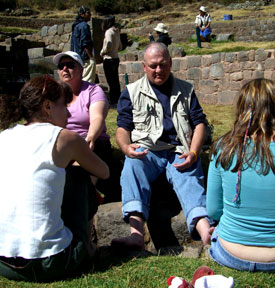 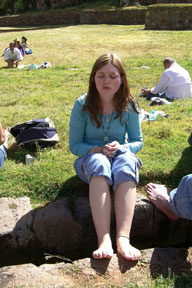
Victor Angles holds that Tipon could have been the Royal House of Yahuar Huaca, who retreated here after being defeated by the Chancas. His son Wiraqocha faced the Chancas and defeated them, being crowned Inka instead of his father.
Garcilaso de la Vega wrote the following: "It was determined that the son, as most of the court decided, would be the head of the kingdom; and to avoid riots and civil wars, they accepted everything the prince wanted. After it was agreed, they obtained a Royal House, between Muyna and Quepicancha, in a pleasant place with all the gifts, fields, gardens and other royal amusements for hunting and fishing. The house was built close to the Yucay river.." Angles assumes that the place identified by Garcilaso is Tipon.
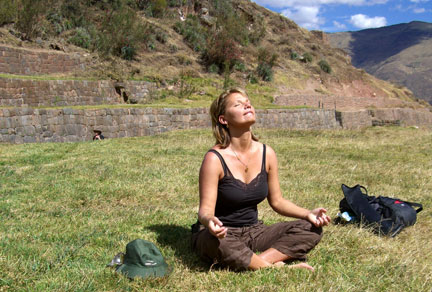
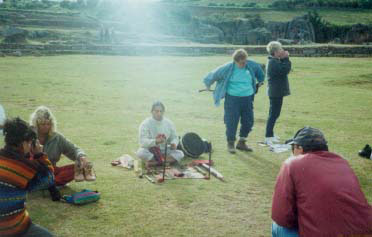
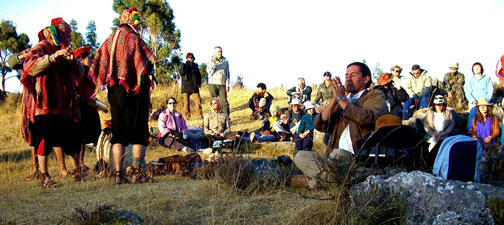
The Watanay river passes close to Tipon and two small rivers flow out of it to surround the complex. These could be the small rivers that the Garcilaso wrote about. Muiuparka: A vortex where Inkas performed rituals to create perfect union with the Creator and Cosmic energy (phenomenal healings occur here.)
 DAY 5: DAY 5:
MORAY PACHAMAMA CENTER - CHINCHERO (Led by MALLKU)
In the morning visit to Moray, a powerful Inka site with circular terraces that used to create exceptional conditions or micro climates that fostered domestication, acclimatization and hybridization of a wide array of wild vegetable species that were modified or adapted for human consumption. Continue to visit Chinchero which is an amazing Earth Altar. Discover the Magic Hatun Chinkana of this initiatory center. This Waka or sacred place is as the Brain and with its vibration will permit to travel to the dimension of the soul.
Return to the hotel and resting. Overnight Cusco.
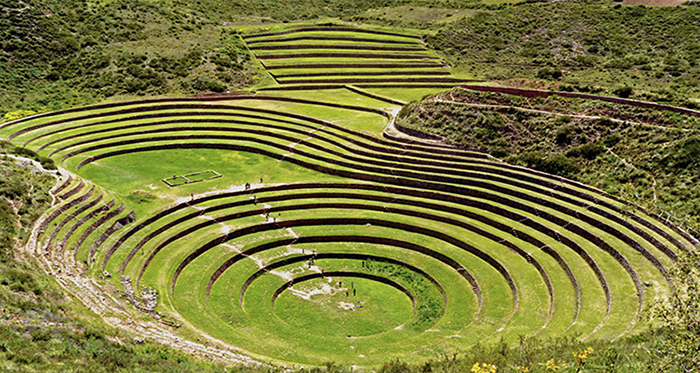
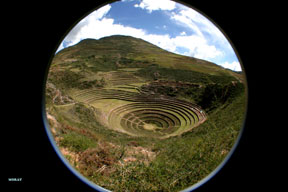 Moray: An archeological site with concentric agricultural terraces, some as deep as 150 meters. This "Earth's Navel" is thought to be a large agricultural laboratory where the Inkas created different microclimates to grow a large variety of crops. Here we may perform a metamorphosis ritual, attuning our body/mind with electromagnetic energy from Earth's Navel. An important fact of the Inka's technology was that its works harmonize perfectly with nature. They used the natural forces, they mastered hydraulic engineering, and knew the use of the earth. For instance, thanks to the "andeneras" (agricultural circular terracing) system, they could sow in abrupt places and avoid the erosion. The attractiveness of this area can be distinguished for its impressive landscape (nature and big snowy mountains), pleasant climate, fertile lands with abundant water, megalithic cultural evidences, people and its traditions. Moray: An archeological site with concentric agricultural terraces, some as deep as 150 meters. This "Earth's Navel" is thought to be a large agricultural laboratory where the Inkas created different microclimates to grow a large variety of crops. Here we may perform a metamorphosis ritual, attuning our body/mind with electromagnetic energy from Earth's Navel. An important fact of the Inka's technology was that its works harmonize perfectly with nature. They used the natural forces, they mastered hydraulic engineering, and knew the use of the earth. For instance, thanks to the "andeneras" (agricultural circular terracing) system, they could sow in abrupt places and avoid the erosion. The attractiveness of this area can be distinguished for its impressive landscape (nature and big snowy mountains), pleasant climate, fertile lands with abundant water, megalithic cultural evidences, people and its traditions.
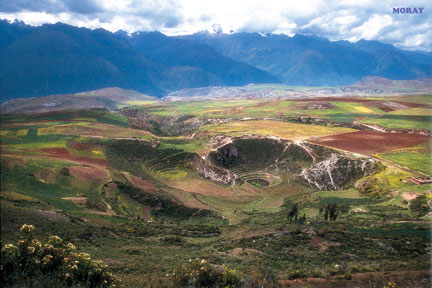
The Inka masters left structures in harmony with nature in many places and today we discover Moray, an energetic center that honors Pachamama with its forms that spread forces towards the sky. Chinchero is the initiatory center to allow us to activate our brain and other vital centers.
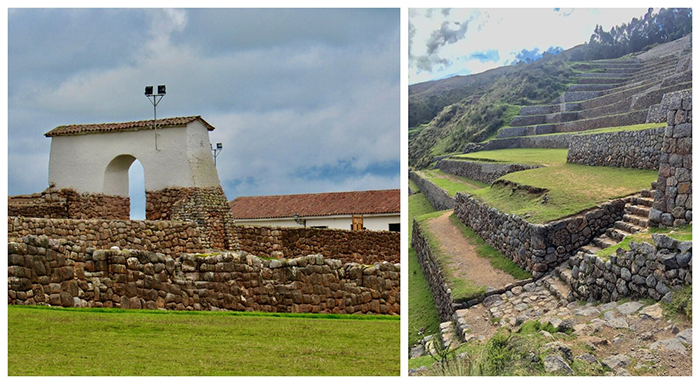
Chinchero: called "El Pueblo Del Arco Iris" (the town of the
rainbow), is high up on a spectacular place, around 12,000 feet
above sea level, with tremendous views of the Urubamba mountain
range as well as the majestic Salkantay mountain that reaches
almost 19,000 ft. Chinchero is halfway between the Sacred Valley
and Cusco, to the northwest of Cusco, at 28 km. (17.4 miles). The
town of Hispanic architecture is built on old Inka constructions.
Its people are very conservative of some andean traditions, wearing
picturesque clothing. On Sunday is the day of the
"qhatu"(market)--exchange fair of agricultural products, in which
the use of the currency is discarded and everything is made in
exchange. Also outstanding the textile crafts (crafts as well as
local produce).
 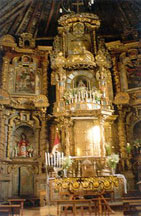 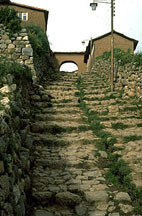
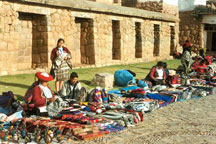 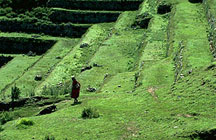
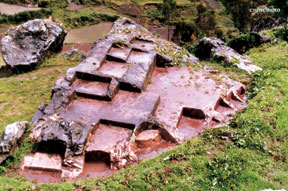 
There is a spectacular view of the valley and beautiful
Andean landscapes surround the town, outstanding the beauty of the
snowy mountains Chicon and Veronica of the Mountain Range of
Urubamba. In Chinchero is a spectacular altar, clustered in alpine
flowers and surrounded by snow covered mountains. Here we will
participate in a ceremonial prayer for mother earth (Pachamama),
safety in our travels, and our own personal wishes. The offering
may consist of nuts, seeds, petals, leaves, herbs, stones, corn,
wool and other elements.
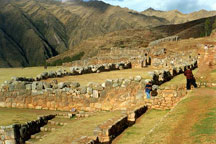 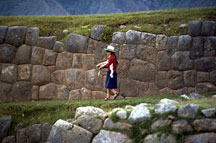
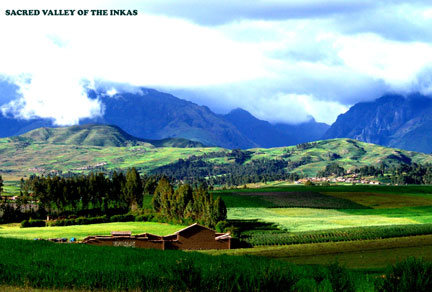
Urubamba
Valley: One hour by bus north west of Cusco lies the valley of
the Urubamba River. It's easy to see why the valley was considered
sacred by the Inkas with its spectacular panoramas and fertile
alluvial low lands. The Urubamba Valley, is one of the most fertile
valleys on this planet. Everything that is planted here grows with
such abnormal vigor - especially corn. The corn here grows
approximately three times the size of the corn grown in the U.S.
and other parts of the world. This valley is located in both sides
of the river Vilcanota and their tributaries. These men gave life
to the stone and they built urban centers, palaces, temples,
agricultural constructions, and trails.
Standing guard
over the winding river valley are the spectacular temples of Pisac,
Ollantaytambo and finally Machu Picchu. The river then continues on
into the tropical rain forest of the Amazon Basin.
DAY 6:
TEMPLE OF THE SUN and CAVE OF THE SERPENTS (Led by MALLKU)
In the morning we will visit the amazing remains of the Temple of the Sun – QORIKANCHA (Coricancha) in Cusco. In the right time, Pachamama - Mother Earth invites us to go deep in ourselves as we connect with the ancient Cave of the Serpents: Amaru Machay. Guided ceremonies at this powerful location; Mallku will unveil the magic of the ancestors and the esoteric wisdom of the heavens where astronomy was the base to understand a practical life as a way of meditation. Pachamama - Mother Earth invites us to go deep in ourselves as we connect with the ancient caves of the Serpents. Open your inner temple for a personal rebirth.
Afternoon return to Cusco. Overnight in Cusco.
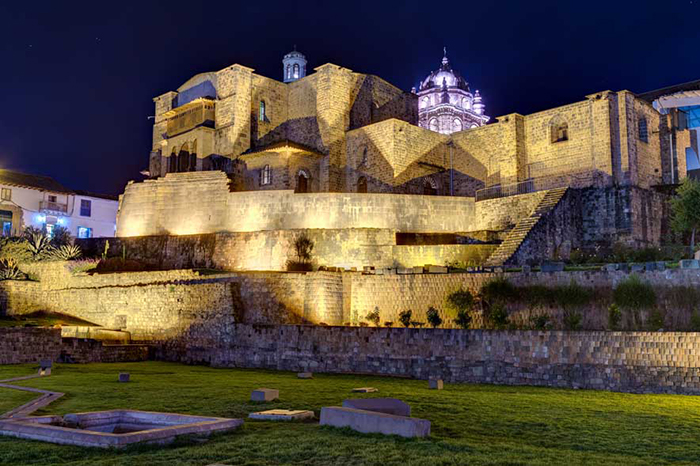
Qorikancha: Originally named Intikancha or Intiwasi, the Temple of the Sun was dedicated to Inti (Sun God), and is located at Cusco, the former Inka capital. Most of the temple was destroyed after the 16th-century war with the Spanish conquistadors, and settlers scavanged the stones to build their own churches and residences. Much of its stonework formed the foundation for the seventeenth-century Santo Domingo Convent—built after the 1650 earthquake destroyed the first Dominican convent.
To construct Coricancha, the Inka used ashlar masonry—the placement of uniformly sized, cut, and shaped cuboid stones. Stones with a slight imperfection or break were rejected. Due to the arduous labor needed to construct buildings with ashlar masonry, this form of construction signified the Inka's imperial power to mobilize and direct local labor forces. The replication throughout Andean South America of Inka architectural techniques expressed the extent of Inka control over a vast geographic region.
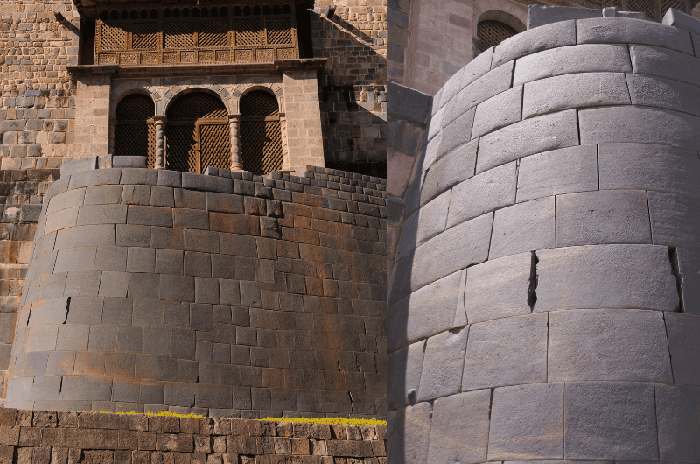
Pachakutiq Inka Yupanqui rebuilt Cusco and the House of the Sun, enriching it with more oracles and edifices, and adding plates of fine gold. He provided vases of gold and silver for the Mama-cunas, nuns or cloistered women, to use in the veneration services. Finally, he took the bodies of the seven deceased Inkas and adorned them with masks, head-dresses, medals, bracelets, and sceptres of gold, placing them on a golden bench.
The walls were once covered in sheets of gold, and the adjacent courtyard was filled with golden statues. Spanish reports tell of an opulence that was "fabulous beyond belief". When the Spanish in 1533 required the Inka to raise a ransom in gold for the life of their leader Atahualpa, most of the gold was collected from Coricancha.
This is one of numerous sites where Spanish colonists incorporated Inka stonework into the structure of a colonial building. Major earthquakes severely damaged the church, but the Inka stone walls, built out of huge, tightly interlocking blocks of stone, still stand due to their sophisticated stone masonry. Nearby is an underground archaeological museum that contains mummies, textiles, and sacred idols from the site.
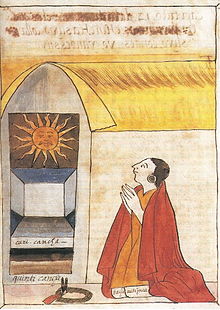 Inka Astronomy: Similarities are found in the semicircular temples found in the Temple of the Sun in Cusco, the Torreon in Machu Picchu, and the Temple of the Sun in Písac. In particular, all three exhibit a "parabolic enclosure wall" of the finest stonework, as Bingham describes it. These structures were also used for similar purposes, including the observation of solstices and Inka constellations. Inka Astronomy: Similarities are found in the semicircular temples found in the Temple of the Sun in Cusco, the Torreon in Machu Picchu, and the Temple of the Sun in Písac. In particular, all three exhibit a "parabolic enclosure wall" of the finest stonework, as Bingham describes it. These structures were also used for similar purposes, including the observation of solstices and Inka constellations.
Within the Milky Way, which the Inka called mayu or Celestial River, the Inka distinguished dark area or clouds, which they called yana phuyu. These were considered silhouettes or shadows of animals drinking from the river water. Amongst the animals named by the Inka, was a llama extended from Scorpius to Alpha Centauri and Beta Centauri, in which those two stars formed the llama's eyes, or llamaq ñawin. A baby llama, llama-cría, was inverted underneath. To the left of the llamas is a red-eyed fox, atuq, which lies between Sagittarius and the tail of Scorpius. The tail of Scorpius is known as a storehouse, or qullqa. A partridge, yutu, was just below the Southern Cross, and a toad, hamp'atu, to the lower right. A serpent, machaguay, extends off to the right.
During the Inti Raymi (June Solstice), the Sapa Inka and curacas would proceed from the Haucaypata, where they greeted the rising June solstice sun, to the inner court of the Coricancha. On a bench in the "sun room", the Sapa Inka sat with the mummies of his ancestors. This and other rooms were oriented northeast–southwest, shingled in gold plate, and embedded with emeralds and turquoise. Focusing the sun's rays with a concave mirror, the Sapa Inka would light a fire for the burnt sacrifice of llamas.
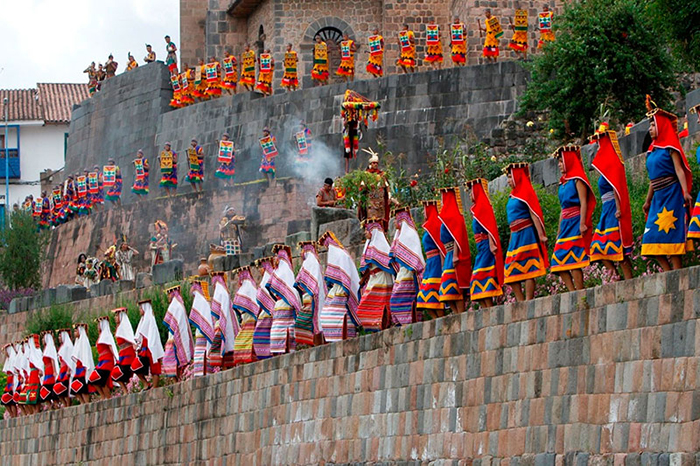
The Coricancha is located at the confluence of two rivers. Here, according to Inka myth, is where Manco Cápac decided to build the Coricancha, the foundation of Cusco, and the eventual Inka Empire. According to Ed Krupp, "The Inka built the Coricancha at the confluence because that place represented terrestrially the organizing pivot of heaven."
Cave of the Serpents: Amaru Machay: The Temple of the Moon is located in the Sacsayhuaman archaeological park. Very strange structures can be found here, including some caves. Offerings to Pachamama are still made on an altar that looks like a layer of metallic sheen once covered it. The cave features mirror-like shining surfaces, vitrified rock borders on the walls, and pieces of the rock that look like they cut big parts out of the mountain as if it was a giant cheese. A shiny snake form in the rock can also be found. Discover and meditate at
this amazing place of initiation
related to the feminine energies.
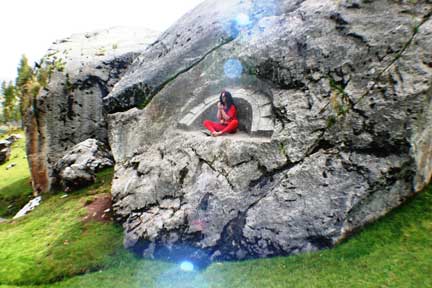
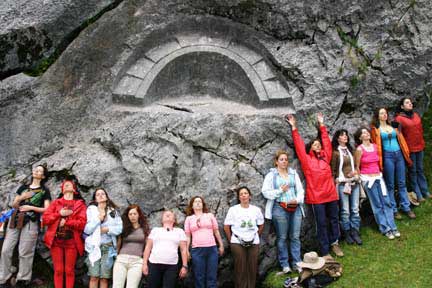
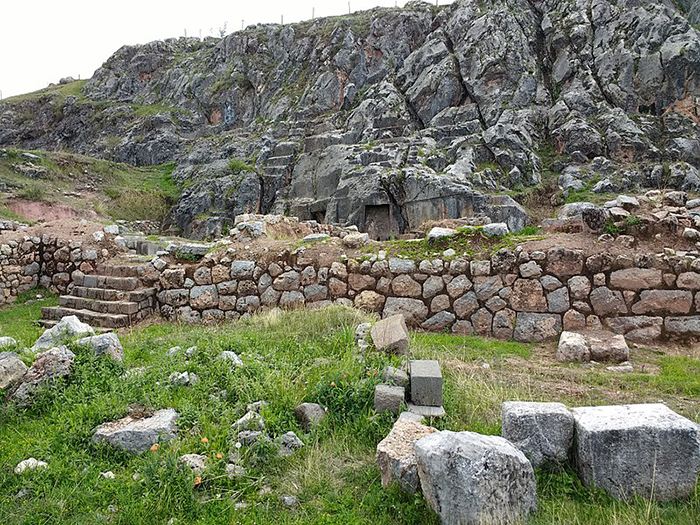
DAY 7:
KONDOR CONNECTION (Led by MALLKU)
Discovery at the Kondor Canyon: beautiful walk to visit the Canyon of Chonta to have possibilities to meet with the Kondors and connect with their spirit. The canyon is spectacular and will allow you to deepen in the beauty and power of Pachamama for a personal expansion as you discover your personal power animal.
The Chonta Canyon awaits us today for a hike to reach surprising scenarios at the heights of the Apurimaq River. In this reserve we can have the opportunity to watch the Kondor’s glide. Just the fact that we are in these mountains is already a gift from Pachamama, and if we have the chance to see the Kondors, we will feel the force of heaven and earth expressed in gigantic proportions. (BOX LUNCH)
At the right time return to Cusco. Overnight Cusco.
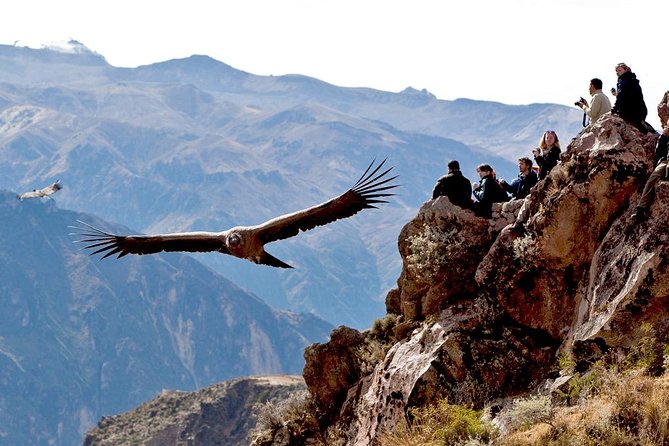
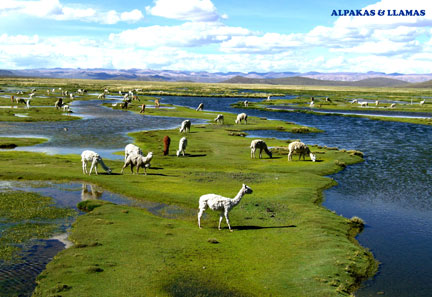
DAY 8:
KIMSAQOCHA LAGOONS (Led by MALLKU)
Little adventure to discover the lagoons of Kimsaqocha to connect with the energy of Apus and the spirit of water. And in the afternoon visit to the mountain overlooking the Inka community of Pisaq, which is considered an archaeological and initiatory treasure. There you will explore one of the most important Inka towns in the Sacred Valley, famous for its Temple of the Sun. At the Inka altars and ceremonial places you will experience an intense meditation to discover your superior abilities.
Connect with the spirit of the mountains and the water as we reach these gorgeous lagoons. Today the mountains call us to discover the lakes of Kimsaqocha. Nature expresses itself with spectacular formations inviting us to connect with the force of water as a source of life and an energetic activator to purify us. In a Vision Quest exercise we performed a meditation to enter the parallel world of the magic of Being. (BOX LUNCH)
At the right time we will return to Cusco and resting. Overnight Cusco.
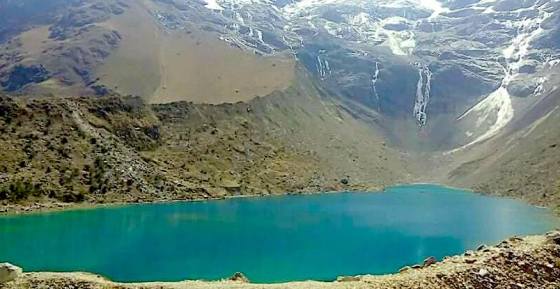
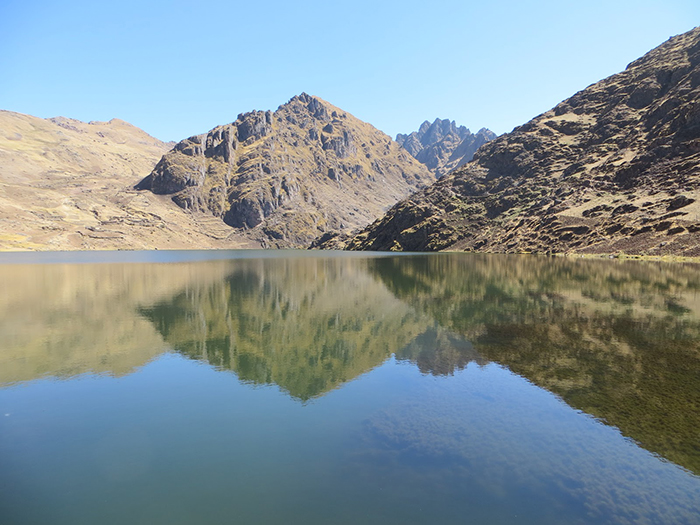
DAY 9:
INKA CITY OF CUSCO (Led by MALLKU)
Easy walk at the amazing Inka streets in Cusco to connect with the ancient energies as a step deepening into the Andean cosmology and personal preparation to discover more of the Inka ancestors. In the afternoon open time for personal discoveries of the beautiful city, time for shopping and other exploration.
Overnight Cusco.
Cusco: The sacred city of Cusco, center of the Inkan empire, was
designed by the legendary Inka Pachakuti in the physical shape of a
Puma. At 11,200 ft. above sea level, Cusco is the heart of the
Tawantinsuyo, Peru's pre-Colombian Empire. Cusco today is the
oldest continuously inhabited city in South America, a fascinating
and colorful paradox of the past and the present. When this ancient
city was the Tawantinsuyo's Capital it also must have been the
biggest and most important metropolis of the continent. Pedro
Sancho de la Hoz, a Spanish soldier who acted as Pizarro's
secretary, wrote in 1543 that in the city were found more than
100,000 houses. Santiago Agurto following relative population
densities estimates about 126,000 persons for the urban zone and
about 100,000 for the rural one, that is, a total population of
about 225,000 inhabitants. Today Cusco is considered the oldest
living city in the American Continent with a continuous occupation
of about 3,000 years until today.
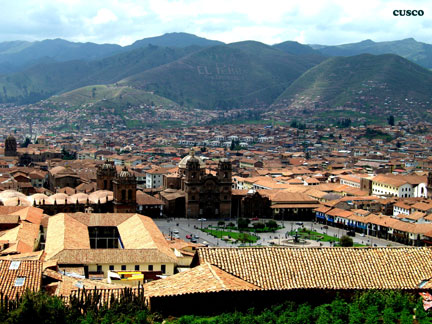
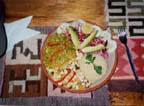 What is traditionally known as the Inka civilization
(empire or state) began approximately by 1200 A.D. in its initial
phase, and later around 1400 A.D. in its expansive phase. One of
the most difficult epochs in the city's life was begun in 1533 with
the arrival and subsequent Christian invasion and ethnocide.
November 15th 1533, Francisco Pizarro refounded it for the Spanish
King following the Christian tradition on March 23rd 1534; with the
name and title of: THE VERY NOBLE AND GREAT CITY OF Cusco. In 1535
Pizarro founded the new capital in Lima that immediately gained
importance and power even until today. In 1536 Manko Inka began a
long and bloody war against the Christian invaders having a siege
of 8 months over the city. Finally in 1572, after a war that lasted
36 years, Tupaq Amaru I, the last emperor of the Inkan dynasty was
defeated, captured and executed cutting his head off in Cusco's
Main Square. What is traditionally known as the Inka civilization
(empire or state) began approximately by 1200 A.D. in its initial
phase, and later around 1400 A.D. in its expansive phase. One of
the most difficult epochs in the city's life was begun in 1533 with
the arrival and subsequent Christian invasion and ethnocide.
November 15th 1533, Francisco Pizarro refounded it for the Spanish
King following the Christian tradition on March 23rd 1534; with the
name and title of: THE VERY NOBLE AND GREAT CITY OF Cusco. In 1535
Pizarro founded the new capital in Lima that immediately gained
importance and power even until today. In 1536 Manko Inka began a
long and bloody war against the Christian invaders having a siege
of 8 months over the city. Finally in 1572, after a war that lasted
36 years, Tupaq Amaru I, the last emperor of the Inkan dynasty was
defeated, captured and executed cutting his head off in Cusco's
Main Square.
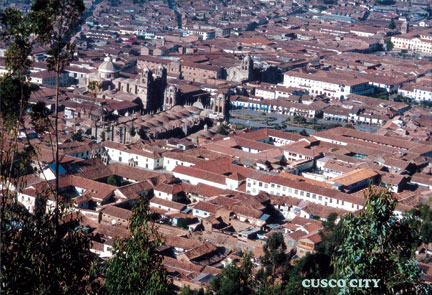
Santo Domingo: This church is built over what once was the most
magnificent temple in the Americas, Qorikancha or Temple of the
Sun. Its courtyards were filled with life-sized gold and silver
representations of all the flora and fauna of the Empire. Pizarro's
men looted the temple as part of Inka Atahualpa royal ransom who
was held prisoner in Cajamarca by the Spaniards and later killed.
An earthquake destroyed the Santo Domingo church in 1950 revealing
the Inka walls that were hidden or plastered over. These walls of
the Temple of the Sun are some of the finest example of Inka
stonework in existence.
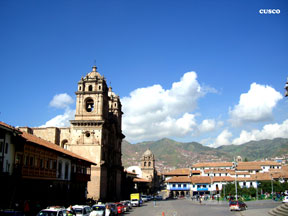 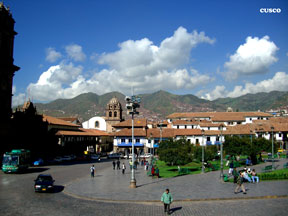
Plaza de Armas:Called Wakaypata by the Quechuas, signifies cry
or moan, and originated in the expressions of reverence and
celebrations with which the priests or military ceremonies were
carried out in this place.
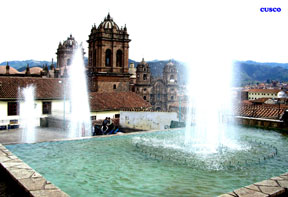 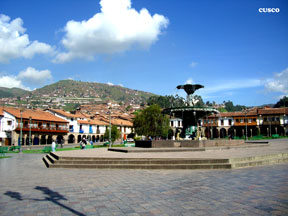
DAY 10:
CUSCO TO LAKE TITIKAKA
(Our team guide or Mallku if group has 8 or more participants)
 Nice trip to Titikaka. On the way visit to the Temple of Wiraqocha. This is one of the most mysterious constructions, a complex dedicated to Earth and Heaven. This temple was built with volcanic stones containing molecules of fire. After the visit, continuation of your trip by comfortable bus to Puno. Lunch then continuation of this pleasant road to Puno, a city that is located on the shore of the magnificent Lake Titikaka, in the South East of Peru. Sumptuous road on the Altiplano, landscape of glaciers, mountains and valleys. (LUNCH) Nice trip to Titikaka. On the way visit to the Temple of Wiraqocha. This is one of the most mysterious constructions, a complex dedicated to Earth and Heaven. This temple was built with volcanic stones containing molecules of fire. After the visit, continuation of your trip by comfortable bus to Puno. Lunch then continuation of this pleasant road to Puno, a city that is located on the shore of the magnificent Lake Titikaka, in the South East of Peru. Sumptuous road on the Altiplano, landscape of glaciers, mountains and valleys. (LUNCH)
Overnight in Puno.
Raqchi: On the road from Cusco to Puno in the town of Raqchi lies an Inkan city-temple, dedicated to the most important entity Wiraqocha. Raqchi is found on the right bank of the Vilcanota River, at an altitude of 3500 mts. (11500 ft.). Apparently its pre-Hispanic name was "Cacha" and not "Raqchi." Raqchi was a complex village with multiple constructions for various purposes; including farming terraces, "kanchas" (plazas), "wayranas" (buildings having only 3 walls), "qolqas" (storehouses), different shrines, water fountains, etc.
Wiraqocha Temple:  The most important building within the complex is the "Wiraqocha Temple", built by Inka Wiraqocha in homage to the Superior Invisible Entity of Andean people: "Apu Kon Titi Wiraqocha." The shrine was built after the appearance of a man who began performing miracles, and the village inhabitants decided to stone him to death. After searching for him, they found him knelt with arms extended skyward. Immediately, a fire rain fell. With remorse the men left him free. That strange man went toward the coast and submerged into the ocean waters, disappearing forever. Thereafter, a shrine was constructed in his memory, as well as the sculpture of a stone representation. Concerning the fire rain, it may have been an eruption of the presently extinguished volcano "Kinsach'ata." There is a great quantity of dried lava (volcanic rock) around the area. The most important building within the complex is the "Wiraqocha Temple", built by Inka Wiraqocha in homage to the Superior Invisible Entity of Andean people: "Apu Kon Titi Wiraqocha." The shrine was built after the appearance of a man who began performing miracles, and the village inhabitants decided to stone him to death. After searching for him, they found him knelt with arms extended skyward. Immediately, a fire rain fell. With remorse the men left him free. That strange man went toward the coast and submerged into the ocean waters, disappearing forever. Thereafter, a shrine was constructed in his memory, as well as the sculpture of a stone representation. Concerning the fire rain, it may have been an eruption of the presently extinguished volcano "Kinsach'ata." There is a great quantity of dried lava (volcanic rock) around the area.
The "Wiraqocha Temple" is a grandiose construction for its era. Architectonically it is classified as "kallanka"; that is, a large building completely covered with a thatched roofing (wood and "ichu").
DAY 11:
UROS ISLAND - AMANTANI LOVE ISLAND (Our team guide or Mallku if group has 8 or more participants)
Discover the magic of lake Titikaka as navigating at the highest navigable lake on the world. Lake Titikaka is the female pole of the planet and the island with the community members will help to travel in time. On the way to Amantani island we stop at a floating island of the Uros community. Late afternoon opportunity for personal meditation at Sunset. Overnight at the homes of the villagers. (LUNCH + DINNER)
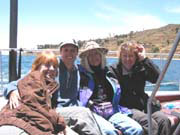 Lake Titikaka Legend: Titikaka ("Rock of the Puma") was, according to Andean legend, the birthplace of civilization. Wiraqocha, the creator, brought light into a dark world by directing the Sun, Moon and stars to rise up out of the lake and take their place in the sky. With time the Sun and Moon had children who also rose from the depths of the lake. These new people were sent out from Titikaka to the four corners of the earth, with Mallku Qhapac and his sister Mama Oqllo and their family clan being sent off to inhabit the Cusco region. Inka legend believed that Mallku was the first Inka and a direct descendent from the Sun. Lake Titikaka Legend: Titikaka ("Rock of the Puma") was, according to Andean legend, the birthplace of civilization. Wiraqocha, the creator, brought light into a dark world by directing the Sun, Moon and stars to rise up out of the lake and take their place in the sky. With time the Sun and Moon had children who also rose from the depths of the lake. These new people were sent out from Titikaka to the four corners of the earth, with Mallku Qhapac and his sister Mama Oqllo and their family clan being sent off to inhabit the Cusco region. Inka legend believed that Mallku was the first Inka and a direct descendent from the Sun.
The supposed location in Titikaka of the birthplace of the Sun, Moon and Mallku Qhapac is actually on the Bolivian side of the lake on the islands named the Isla del Sol (Island of the Sun) and Isla de la Luna (Island of the Moon).
In Inka mythology, Mallku Qhapac and Mama Oqllo, children of the Sun, emerged from the depths of Lake Titikaka to found their empire. Like famous naturalist Jacques Cousteau, today's visitors to Titikaka will surely feel the same emotion that captivated the symbolic universe of the ancient Peruvians. With lofty snow-capped peaks along its far shores, the vast blue lake at 3,810m is one of the Andes' most enchanting scenes.
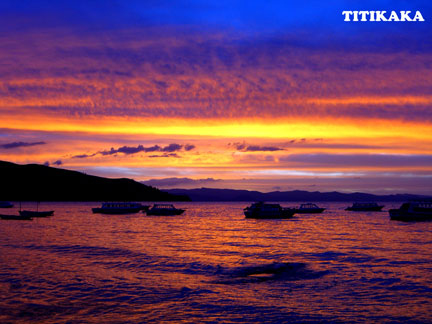
 Lake Titikaka statistics: The world's highest lake navigable to large vessels, lying at 12,500 feet (3,810 m) above sea level in the Andes Mountains, astride the border between Peru to the Northwest and Bolivia to the Southeast. Titikaka is the second largest lake of South America (after Maracaibo). It covers 3,350 square miles (8,600 square km) and extends for a distance of 120 miles (190 km). It is 40 miles (65 km) across at its widest point. A narrow strait, Tiquina, separates the lake into two bodies of water. The smaller, in the Southeast, is called Lake Winay Marka which belongs to Bolivia; the larger, in the Northwest, is called Lake Chucuito and belongs to Peru. Lake Titikaka statistics: The world's highest lake navigable to large vessels, lying at 12,500 feet (3,810 m) above sea level in the Andes Mountains, astride the border between Peru to the Northwest and Bolivia to the Southeast. Titikaka is the second largest lake of South America (after Maracaibo). It covers 3,350 square miles (8,600 square km) and extends for a distance of 120 miles (190 km). It is 40 miles (65 km) across at its widest point. A narrow strait, Tiquina, separates the lake into two bodies of water. The smaller, in the Southeast, is called Lake Winay Marka which belongs to Bolivia; the larger, in the Northwest, is called Lake Chucuito and belongs to Peru.
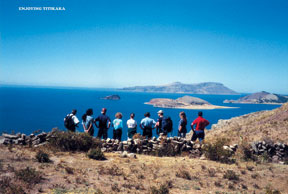
The meaning of the name Titikaka is uncertain, but it has been variously translated as Rock of the Puma, Stone Puma, or Crag of Lead. In the snow-covered Cordillera Real on the Northeastern (Bolivian) shore of the lake, some of the highest peaks in the Andes rise to heights of more than 21,000 feet (6,400 m).
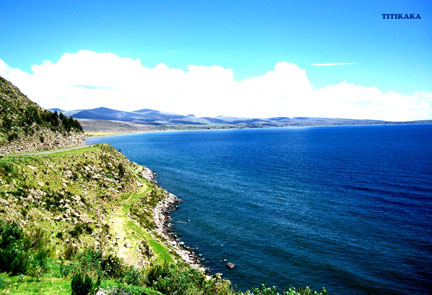
The lake averages between 460 and 600 feet (140 and 180 m) in depth, but the bottom tilts sharply toward the Peruvian shore, reaching its greatest recorded depth of 920 feet (280 m) around the Soto island in the lake's Northeast side.
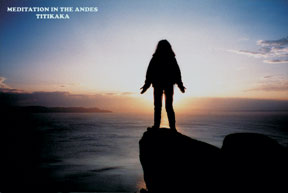 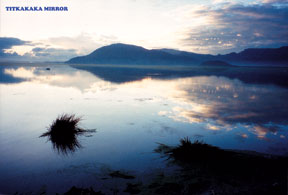
More than Forty islands rise from Titikaka's waters. The largest, Titikaka Island (Spanish: Isla de Titikaka, also called Isla del Sol), lies just off the tip of the Copacabana Peninsula in Bolivia. There are several islands that can be accessed from Puno City. The most popular of these are the islands of Uros, Taquile and Amantani.
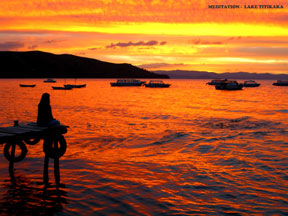 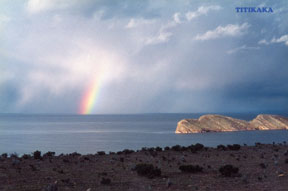
Ruins on the shore and on the islands attest to the previous existence of one of the oldest civilizations known in the Americas, antedating the Christian era. The chief site is at Tiwanaku, Bolivia, at the Southern end of the lake.
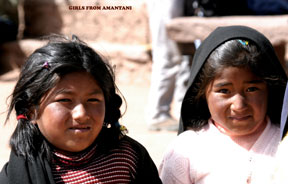 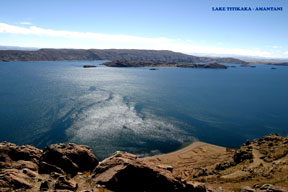 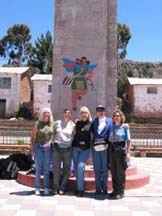 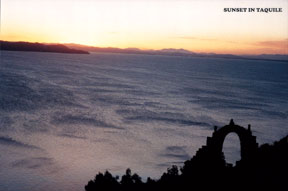
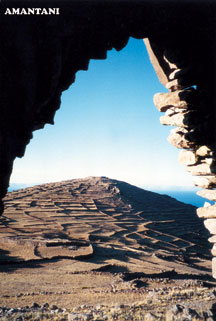 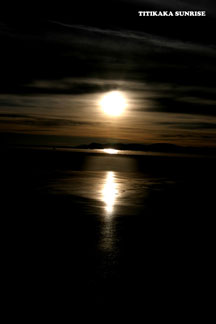
Amantani Island is located 38 km from the city of Puno, 3,810 meters above sea level, 3,5 hours by motorboat. Amantani is a beautiful island with warm and hospital inhabitants. Its greatest attraction is based on the social, ethnic and archaeological aspects. Among its most important and well-known places are the temples of Pachatata and Pachamama dedicated to the cult of the earth and heaven. From there on you can have an excellent panoramic view of the lake, as well as a view of the oriental mountain range and the Bolivian side with its mountain range.
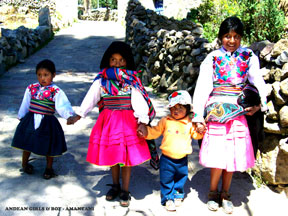 
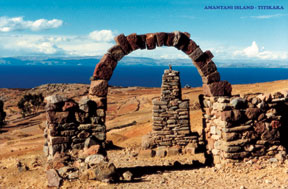 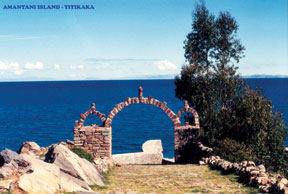
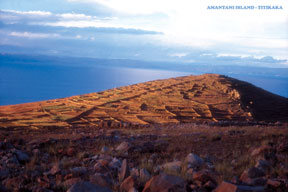 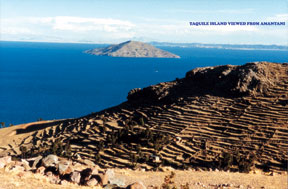
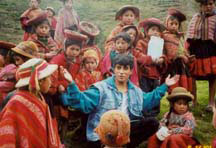 Lake Titikaka and the House of the Golden Sun Disc. Peru is a land steeped in ancient wisdom that is vital for our planet during these transitional times. Life in the Inkan empire was measured by a thousand year cosmic cycle called an Inti, which means 'Sun'. This thousand year cycle was then divided into halves, each of which was referred to as a Pachakuti ("he who transform the earth"). The cosmovision of the Andean world is the conception of duality that is in permanent opposition, but complementary, like the principle of ying/yang that expresses this opposition. This same principle of duality applies to each Pachakuti. However, Pachakuti also refers to the transitional time that divided each Pachakuti and this is characterized as a time of great changes. Lake Titikaka and the House of the Golden Sun Disc. Peru is a land steeped in ancient wisdom that is vital for our planet during these transitional times. Life in the Inkan empire was measured by a thousand year cosmic cycle called an Inti, which means 'Sun'. This thousand year cycle was then divided into halves, each of which was referred to as a Pachakuti ("he who transform the earth"). The cosmovision of the Andean world is the conception of duality that is in permanent opposition, but complementary, like the principle of ying/yang that expresses this opposition. This same principle of duality applies to each Pachakuti. However, Pachakuti also refers to the transitional time that divided each Pachakuti and this is characterized as a time of great changes.
During the five hundred years of the eighth Pachakuti, Pachacuteq, the greatest spiritual leader of the Inkas and the builder of Machu Picchu ruled. This was a time of light when the Inka Empire flourished and there was expansion and good fortune.
The ninth Pachakuti, on the opposite side of the duality, brought with it the five hundred years of darkness when the Spanish invaded the Andes. We are now entering the tenth Pachakuti, which the Andean people refer to as the returning of Pachacuteq, the returning of the Light. This is the time when the etheric crystal cities of the fourth dimension such as the lost golden city of Paititi and the eternal etheric city under lake Titikaka will again be available to us.
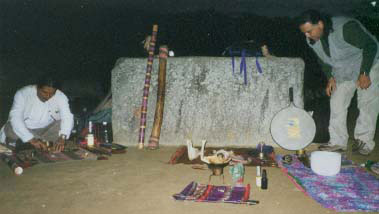
One of the Solar Discs in the Inka time that was at Cusco, and placed in the Qorikancha, the main Temple of the Sun, stayed there until the coming of the Spanish. At that time, it was returned to Lake Titikaka and placed in the Eternal Etheric City inside the Lake. In the legend of their origin, this is the place from where the first Inkas, Mallku Qhapak and Mama Oqllo, entered the Earth.
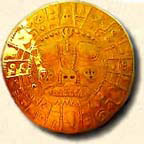 Mallku Qhapak and Mama Oqllo Mallku Qhapak and Mama Oqllo
The Solar Disc was used in the capacity of a cosmic computer that received light information directly from the Universal Mind Source, Wiraqocha, at the Universe. By entering the Temple of Illumination and opening themselves, the Inkas could access the sacred wisdom. During this age of Pachakuti, the sacred Solar Disc is to be re-activated accessing the cosmic wisdom. Many of the world's spiritual leaders, as well as indigenous teachers, acknowledge the energy of the Andes, which is the expression of the feminine electromagnetic light, having its center in the Lake Titikaka. This area is the acknowledged portal through which the new feminine energies are entering Mother Earth 'Pacha Mama."
We wonder how pre-Columbian and other great cultures had precise knowledge of astronomy, of planetary and sidereal dimensions, without possessing the technology of today. These ancient peoples built cities with solar orientation, knew about geographic and magnetic North, verified the precession of the equinoxes, arrival of the solstices, passage of the Sun at the zenith, inclination of the axis of the Earth's rotation axis in accord with the ecliptic (Earth's orbital plane), and elliptical orbit of the Earth around the Sun. This is the mystery of the ancients, awakening wonder and awe as we visit Peru's sacred sites.
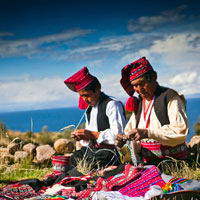
DAY 12:
AMANTANI - TAQUILE - PUNO (Our team guide or Mallku if group has 8 or more participants)
Today continue with the energy of the lake and discover the neighbor island of Taquile, a special place where men are the specialist of the weaving techniques. Return to Puno in the afternoon and over night. (LUNCH)
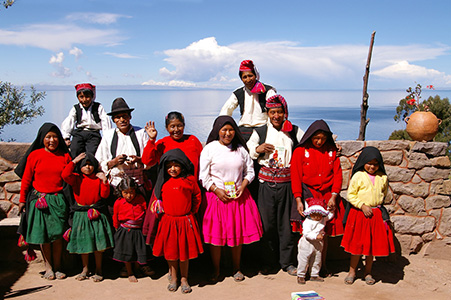
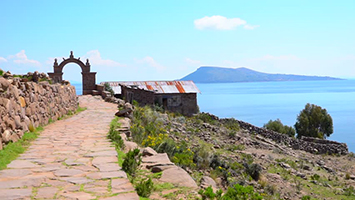 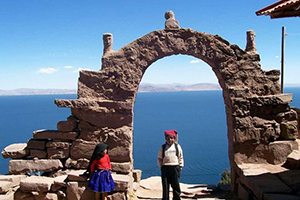
DAY 13:
AJAYU MARKA DIMENSIONAL DOORWAY - PUNO (Our team guide or Mallku if group has 8 or more participants)
The Andean masters worked a lot in nature where Pachamama left signs and today connect with the Portal of Inner Dimension as approaching the Ajayu Marka or Willka Uta, a Portal that was baptized as Aramu Muru.
In the right time return to Puno for lodging.
Ajayu Marka, Titikaka: Walk the sacred path on the Magical Serpent and discover the Ajayu Marka, a dimensional world with its doors. We walk to the Magical Power source of the Ajayu Marka, House of the ancient Spirits and Masters and the dimensional doorway of the Ancient Ones. House of the spirits--an interdimensional doorway. The Ancients created the main altars to the Sun in the Aimara regions. We will travel to "Ajayu Marka" to walk on the back of the Cosmic Serpent before arriving to revel in and experience the vortex energy of the Interdimensional Gate of Aramu Muru, a portal for dimensional shifting and University of the Seven Rays. Experience a ceremony at the Doorway that will help you connect with the powerful Interdimensional energies that flow into this timeless altar. Stand in portals carved out rock on either side of the main alter, to balance your male and female energies.
The experience of placing your 3rd eye on the contact point on the doorway itself can only be described by you as you have your own unique experience.
Aimara People: The Aimara people living in the Titikaka Basin and on the islands still practice their ancient methods of agriculture on stepped terraces that predate Inka times. They grow barley, quinoa (a type of pigweed that produces a small grain), and the potato, which originated on the Altiplano.
Puno City is located in the Southeast corner of Peru, on the
shores of the magnificent Lake Titikaka and only 126km from the
frontier with Bolivia. At 3,827m in altitude, Puno is a melting pot
of Andean cultures including the Aimara from the South and Quechua
from the North. This has earned Puno the title of 'Folkloric
Capital of Peru' which it lives up to well with its huge number and
variety of traditional fiestas, dances and music.
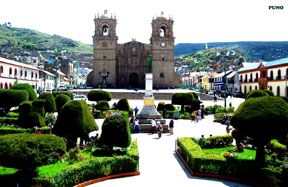 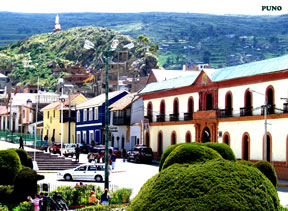
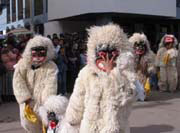 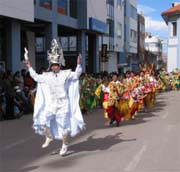
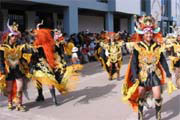
The
city, whose full name is San Carlos de Puno, was founded in 1668
following the discovery of nearby silver mines. Prior to this, Puno
had been a small stopping off place between the much larger silver
mines at Potosi in Bolivia and to the way to Lima.
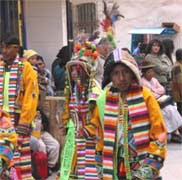 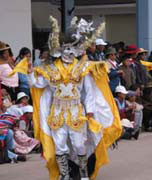
Today, Puno is a predominately agricultural region. Its
main economic activities are cultivating potatoes, barley and
quinoa, as well as raising cattle, sheep, llamas and alpacas. If
you're looking for Peruvian knitwear you'll find the markets in
Puno have a huge selection and are probably the cheapest in
Peru.
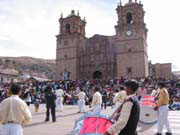
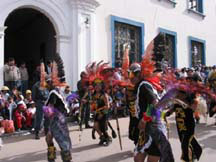
DAY 14:
PUNO - JULIACA flight to LIMA - HOME (Our team guide)
(FLIGHT NOT INCLUDED IN TOUR FEE)
Transfer to the airport at Juliaca (Airport code JUL) for your flight to Lima, arrival and connection to your international flight home and beginning of a new path in your life.
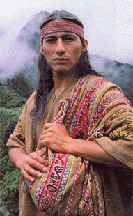 PERU WEATHER: PERU WEATHER:
In general, Peru
has two seasons, wet and dry, but in a country as geographically
diverse as Peru, local weather patterns vary greatly. In the
highlands, the dry season is between May and November, but even the
mountains' wet season is not always wet and the dry season sees
downpours. Temperatures during the day in the dry season can get
hot. At night, temperatures can drop quickly and a warm sweater
makes walking around the plazas comfortable.
The
Mountain Highlands (Cusco, Lake
Titicaca)
Mid April to October.
This period is the dry season, with hot, dry days and cold, dry
nights, often hovering just above freezing, particularly in June
and July. May is perhaps the best month with the countryside
exceptionally lush, yet with superb views and fine weather. You'll
find the flowers in full bloom, the grass green and the streams
full.
November to Mid April
This is the wet season with most rain in January and February. It's
usually clear and dry most mornings with outbursts of heavy rain in
the afternoons. The daily temperatures are typically mild with only
a small drop at night.
The Coast (Lima, Nasca, Arequipa).
December to April
This is summertime on the coast where the weather is hot and dry
and ideal for swimming and getting a tan. Temperatures on average
range from 25 to 35°C. There is little or no rain during these
months.
May to
November
From May to November the temperature drops a bit and you'll find
blankets of sea mist engulfing the coast from the south right up to
about 200 km north of Lima. At this time of year only the northern
beaches such as Mancora and Punta Sal are warm enough to provide
pleasant swimming.
Average
Temperatures and Rainfall
| LIMA |
Jan |
Feb |
Mar |
Apr |
May |
Jun |
Jul |
Aug |
Sep |
Oct |
Nov |
Dec |
| High (°F) |
77 |
79 |
79 |
75 |
70 |
66 |
63 |
63 |
63 |
66 |
68 |
73 |
| Low (°F) |
66 |
68 |
66 |
65 |
61 |
59 |
57 |
56 |
56 |
57 |
61 |
63 |
| High (°C) |
25 |
26 |
26 |
24 |
21 |
19 |
17 |
17 |
17 |
19 |
20 |
23 |
| Low (°C) |
19 |
20 |
19 |
18 |
16 |
15 |
14 |
13 |
13 |
14 |
16 |
17 |
| Wet Days |
1 |
0 |
0 |
0 |
1 |
1 |
1 |
2 |
1 |
0 |
0 |
0 |
| CUSCO |
Jan |
Feb |
Mar |
Apr |
May |
Jun |
Jul |
Aug |
Sep |
Oct |
Nov |
Dec |
| High (°F) |
66 |
66 |
67 |
68 |
68 |
67 |
67 |
68 |
68 |
70 |
69 |
68 |
| Low (°F) |
44 |
44 |
44 |
41 |
37 |
34 |
34 |
34 |
39 |
42 |
43 |
43 |
| High (°C) |
19 |
19 |
19 |
20 |
20 |
19 |
19 |
20 |
20 |
21 |
20 |
20 |
| Low (°C) |
7 |
7 |
7 |
5 |
3 |
1 |
1 |
1 |
4 |
6 |
6 |
6 |
| Wet Days |
16 |
12 |
10 |
7 |
4 |
3 |
2 |
2 |
6 |
8 |
10 |
14 |
WE RECOMMEND
YOU TO:
- Use boots or
athletic shoes during walks.
- Drinking lots of water on long excursions, especially at Lake
Titikaka.
- Always take an umbrella or rainwear.
WATER
The tap water in
most of Peru is potable, but the chemical content varies from place
to place. To avoid problems, we recommend that you always drink
bottled water, which is readily available everywhere for purchase.
Do not drink any tap water, even to brush your teeth. Do not eat
any raw salads, raw fruits or raw vegetables. If you want to purify
your water before drinking it, your can either bring a 220-volt
heating coil for boiling water, or you can use water-purification
tablets or a water purifier, which is available at any camping
store.
VALUABLES
Pickpockets
abound in crowded areas and muggings in Cusco are on the rise.
Therefore you are advised to leave all valuables in the hotel safe,
including passport, credit cards, and other identifying papers. You
are advised to leave valuable clothing, precious jewelry, valuable
papers, and all unnecessary items at home and not take them to
Peru.
HEALTH
Because you are
visiting Andean areas, take precautions to avoid altitude sickness
if you are prone to it. During your first day move slowly and eat
lightly, resting the first couple of hours. Drink lots of bottled
water. We recommend that you get CELL FOOD from a health food
store. This product, created by NASA, has components to produce
oxygen in a liquid form.
Please consult
the CDC website for health information, and please keep in mind
that we will not be visiting any tropical regions in Peru:
http://wwwnc.cdc.gov/travel/destinations/peru.htm
NOTES ON
WALKING:
Some visits involve a lot of walking at very high altitudes. A walking stick can be helpful, and is available to purchase in Peru, if you don't want to bring one.
*Machu Picchu,
from the entrance, we will walk uphill to a viewpoint above the
city, about one mile steep walk. Within the city, many stairs to
climb.
*Amantani Island,
from the port on the island we will walk a distance of one mile
steeply uphill to get to the houses where we will be lodged. The
next morning, the ones who feel ready will climb to the temples,
which are one more mile uphill from the houses. In none of these
place we are running; we are walking and taking our time. The
difference altitude from the port to the temples in the next day is
about 1000 feet. If some feel that they can not make to the temples
can wait in the lower part of the island.
*Ajayu Marka
Dimensional Door Way, from the bus we will walk a few meters to the
first stops, not very far to walk. For the second part, we need to
walk half a mile to get to the Dimensional Doorway. This is
flat.
*Sillustani, here
we will do a walk of about half a mile, with some little climbing,
but accessible.
ARRIVAL AND
DEPARTURE
At the airport in Cusco, as long as you have booked your hotel through us and have notified us of your flight itinerary, you will be met by our representative with a placard that has your name on it, and you will be transported to your hotel. At the time of your departure from Juliaco, our representative will take you to the airport. If you sent us your detailed flight information, you will be all set.
BAGGAGE
Weather and loading and
unloading can cause more than usual wear and tear to luggage in
Peru. Accordingly, all luggage should be capable of withstanding
rain and rugged treatment. For your flights within Peru, the total
number of free checked bags is 2, and the TOTAL combined weight
limit for those 2 bags is 20 kilograms (44 pounds). If you exceed
this weight, you will have to pay a penalty. The maximum size of
each checked bag is 158 cm (60 in) length x width x
height.
Generally as you arrive at
the hotels, you do not need to handle luggage from one place to
another. You have to identify your luggage to the porters of hotels
so they can carry your luggage to your room. We recommend that all
bags have your identification name in order to bring to your room
or to the places you need.
Carry-On Allowance: 1 Bag +
1 Personal Item
Each passenger is allowed
to carry on one bag and one personal item such as a purse or
briefcase. Assistive devices and outer garments do not count as
personal items. All carry-on luggage must fit in the overhead bin
or under the seat in front of you and adhere to the following
requirements:
-
Maximum Weight of Carry-on Luggage for first and business class:
16kg/35lb*
- Maximum Weight of Carry-on Luggage for
economy class: 8kg/18lb
- Maximum Dimensions of Carry-on Luggage:
46 linear inches/115 cm (22x14x10 in/ 55x35x25 cm)
- Maximum Dimensions of Personal Item:
21in x 16in x 8in (length x width x height)
* In addition, first and business class passengers may take a
folding garment bag.
Checked Baggage Allowance
for domestic flights within Peru
-
First class: 88lb/40kg
- Business class: 66lb/30kg
- Economy class: 44lb/20kg
Excess, overweight, and
oversize baggage fees vary by route.
Excess baggage is defined
as:
- An extra piece in addition to the two
check bags permitted.
- Any piece exceeding the permitted
dimensions.
- Any piece weighing 50 lb/23kg -
70lb/32kg: $50
- Any piece weighing 70 lb/32kg -
99lb/45kg will be charged according to the route.
CURRENCY
EXCHANGE
One U.S. dollar =
approximately 2.58 PEN Perun Nuevo Sol (subject to fluctuation).
One PEN = approximately U.S. dollar $.38. You may experience
difficulty in exchanging traveler's checks outside Lima or in
exchanging currency other than U.S. Dollars. Please consider
changing your money in Lima. There is usually a currency exchange
bank at international airports such as in Lima. That would be a
good option for changing money.
Important: If you bring U.S. Dollars to exchange for PEN, or to pay for any goods or services in Peru, the locals will not accept any tears or damages in the currency notes. So bring crisp new notes from the bank.
INSURANCE
Be sure to get
travel insurance in case you need to cancel for any reason. Divine
Travels carries no travel insurance. Please go to: adele@legendaryworld.com.
LAUNDRY
There are laundry
services at the main towns, and the hotels are also doing this
service. In Cusco, after returning from Machu Picchu, you can use
laundry at the hotel or at the different houses in town. Of course
the hotels are always more expensive.
INTERNET
Internet cafes
abound in Peru. You will have the opportunity to connect via the
Internet in many places. There is Internet service all over the
main towns and in some little ones. There are Internet cabins or
Internet cafes in many places, but if you prefer, you can bring
your own laptop with all the accessories to plug in some of the
hotels or even Internet cafes with wireless. In nearly all the
hotels you find some internet services. Some are charging US $2 per
hour, and others offer for free. In towns you pay US $1 per
hour.
VOLTAGE
Be sure to bring
an adapter for Peru/South America so you can plug in to the 220
voltage system in Peru. Usually the wall sockets look the same as
in the USA. But on occasions, you might find a socket for rounded
plugs rather than flat USA-style plugs. Nearly all laptops and cell
phone adapters are already built for dual voltage (110 and 220), so
you would not need a transformer unless you are plugging in
something that is 110 volt only. But if your appliance or device is
110 volt only, you will need to bring a transformer. Otherwise you
will burn out your appliance or device within seconds.
PHONE
CALLS
There are call
centers in all the towns where you can make international phone
calls for about 30 to 50 cents per minute. If you wish to use your
cell phone, you can make arrangements with your phone carrier to
make international calls while you are in Peru.
REMEMBER TO
BRING:
-Passport (and
visa, if required from your country).
-Airplane tickets or E-Ticket page with confirmation number and/or
ticket number.
-Camera and camcorder, and extra batteries, to photograph
interdimensional lights or beings.
-Clothing for Winter (June to Sept.): Temperature can get down to
below freezing.
-Clothing for temperatures listed in chart above. Please note low
temperatures.
-Gloves, scarf.
-Warm jacket.
-Hiking shoes or athletic shoes.
-Warm socks.
-Warm hat or cap.
-Swimming suit (in case there's a clean pool available).
-You can buy alpaca sweaters in Peru.
-Sunscreen.
-Sunhat.
-Toilet paper for emergencies.
-Antiseptic wipes for emergencies.
-Binoculars, if you enjoy them.
-Sunglasses, if needed.
-Seat cushion for rocky or wet ground, if you feel you need
it.
-Rain poncho or other rainwear (it may rain, even during dry
season)
-Gifts for children, such as boxes of crayolas, boxes of pencils,
toys, or clothing.
-A few crystals, sage, or sweetgrass, to give to Pachamama in ceremonies.
-Alarm clock.
-Do not bring expensive jewelry or perfume.
-Plastic bags for dirty and wet clothes.
-Flashlight and extra batteries.
-Backpack, fannypack, and secret pack for valuables.
-Prescriptions, vitamins, and medications.
-Wash kit, water bottle and water purifying tablets.
-Personal first aid kit.
-Immodium for diarrhea.
-May consider bringing oscillococcinum, aspirin, CO-Q10,
E-mergen-C, L-Tyrosine, DMG.
-CELL FOOD: A product for high altitudes, created by NASA, that
produces oxygen in a liquid form.
GIFTS FOR
CHILDREN
About the gifts,
we recommend to bring colors, crayons, pens, notebooks, pencils,
toys, clothes, or others, but not candies or chemical products. The
quantity is never easy to say. For sure, children will love to
receive more than one piece--at least two or more. There will be at
least three or four places where we meet children from communities
or little villages in the Lake Titikaka area.
For Tour Fees or to Register:
CLICK HERE
Email Us:
|
Our Tours are
not affiliated with any particular spiritual path. All are
welcome!
| CONTACT US: |
Divine Travels
818 SW 3rd Ave. #1505
Portland, OR 97204
|
|
CLICK ON LINKS TO OUR TOURS:
|
For Tour Fees or to Register:
CLICK HERE
Email Us:
|
|